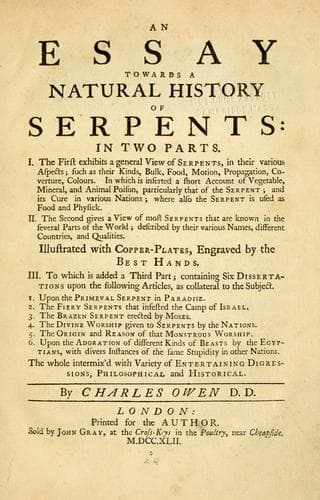
An essay towards a natural history of serpentsOwen, Charles
History
An essay towards a natural history of serpents
Owen, Charles
Serpent worship -- Early works to 1800; Serpents -- Early works to 1800; Serpents -- Religious aspects -- Early works to 1800
When these small harmonious Reptiles go abroad, they travel in Company,
a hundred strong or more, and where they find any asleep, they
immediately seize the Body, and with a Force united and irresistable,
they devour it[279]. Behold! a Conquest by an Army of Worms!
Footnote 279:
_Nierembergii Historia_, cap. xiii. p. 274.
Thus _Herod_ the _Great_, the Proud, the Cruel, when upon the _Throne_,
was attack’d by an Army of Worms, that quickly devoured him. His Body
became _worm-eaten_ like a piece of rotten Wood[280]. Of the Executions
done by Worms, we have divers Instances in the human World. No part of
Man’s Body, whether inward or outward, but is subject to Worms, and have
been tormented with them.
Footnote 280:
γενομενος σχωληχοβρωτος, Act. xii.
Man’s Body, if rightly understood, would appear to be a Granary for
Worms, of divers Colours and Sizes: In the inward Parts, as Stomach,
Guts, Liver, Blood, Gall, Bladder, have been found swarms of Vermin,
sapping the Foundation of the animal Structure. We have Instances of
Worms bred in the human Brains, and were discovered in the Brain of the
_Paris-Girl_ when opened—probably laid, by some Insect, in the Laminæ of
the Nostrils, from whence it gnawed its way into the Brain[281]. So in
the outer parts.
Footnote 281:
_Derham_ from _Bartholinus_.
_GALEN_ in _Jonstonus_ says, that in _Ethiopia_, _India_, and the
mountainous part of _Egypt_, the Inhabitants were tormented with Worms,
that bred in their Legs and Arms, called _Dracunculi_, whose Motion in
the Flesh was conspicuous to the Eye.
_LUCIUS CORNELIUS SYLLA_, _Consul_ and _Dictator_ of _Rome_, (the
Glories of whose Valour were obscured by barbarous Cruelties) died of a
φθιριασις a wormy or lousy Disease: Thus _Aliman_[282], a renowned
_Greek_ Poet, and _Pherecydes_ the Philosopher, and Master to
_Pythagoras_, died of the same loathsome Distemper.
Footnote 282:
_Pliny._ Part. i.
Sed quis non paveat pherecydos fata tragœdi:
Qui nimio sudore fluens, animalia tetra,
Eduxit turpi miserum qua morte tulerunt.
Sylla quoque infelix tali languore peresus
Corruit, & sœdo se vidit ab agmine vinci.
_Sic testatur Serenus medicus._
Public-domain text, read in full here on John Shaqi.
Reviews
Reviews
No reviews yet
Be the first to share your thoughts on this work.
Elsewhere in the archive
Join the Discussion
Join the discussion
Sign in to leave a comment or review.
Sign InorCreate an account