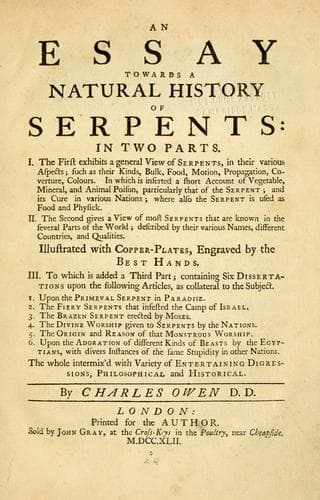
An essay towards a natural history of serpentsOwen, Charles
History
An essay towards a natural history of serpents
Owen, Charles
Serpent worship -- Early works to 1800; Serpents -- Early works to 1800; Serpents -- Religious aspects -- Early works to 1800
So ... there was _Alexander_ the _Great_, and there is _Alexander_ the
_Little_, the ingenious and learned Mr. _Pope_; the one conquered by the
Sword, the other by his Pen, and has made all the Regions of Fame
tributary to him.
CXXIV. The _tame_ and _tractable Serpent_, is of the _Indian_ Race,
about an Inch long, when brought first from the Field for domestick
Education; and when at its full Growth, is not much short of a Man’s
Thigh. Its Habitation is in some little Hutch erected on purpose,
(_indulgentiæ gratia_) where it idles away its time, till Hunger brings
it out. Upon its Approach to the Master of the House, it creeps up to
his Shoulders, where the Embraces of that terrible Creature (being made
tame) are received with Delight[291].
Footnote 291:
_Nierembergius_, cap. xl. p. 283.—Humeros heri amicè conscendunt,
benevolè terrifici animalis amplexus tolerantis.
CXXV. The _Tleoa_, or _Tetloa_, that is, a little fiery Serpent, and
very common in the new World, and described by the Historian thus[292],
_viz._ ’Tis about a Finger broad, and five or six Foot long, and
differenced from others by a Medley of Spots, compounded of white,
black, yellow, and dun Colours. The Head is like that of our Vipers, and
the Tail, which seems to have a touch of the Rattle, ends acutely.
Footnote 292:
_Nierembergius_; from _Franciscus Hernandus_.
Its Wounds are deadly, and burn like Fire; hence the Name it bears:
Though fiery in Nature, is slow and winding in Motion, and may be
avoided by the Traveller, if he has Eyes and Ears. Its usual Residence
is in Mountains, and the higher Mountains are, the greater the Cold,
(because they only receive direct, and but little of the reflected Rays
of the Sun) yet are the Habitations of fiery Animals.
The Learned observe, there are Mountains a Mile and an half high, to the
tops of which, no Vapour, and consequently no Clouds, can ever reach:
And hence it is that in very high Mountains, as the _Pico de Theide_ in
_Bohemia_, though the middle part be always inverted with Snow, and the
bottom scorched with intolerable Heat; yet on the top you will find
yourself in a pure, thin, serene Air, and view the Clouds hovering at a
considerable distance below you[293].
Footnote 293:
_Montibus Tepeztlanicis._
Hence it is that all Thunder is confined within less than a Mile’s
Height. The Air is coldest in the highest places, and hottest in the
lowest; but in the intermediate Atmosphere, where we live, very unequal:
but no Climates, however situated, are privileged with Exemption from
venemous Creatures, and where they are less pestered with them, ’tis
owing to the Cultivation of the Land.
The Wounds given by this Serpent are dangerous, and cured by an Herb
called _Ancola_, by _Jonstonus_, p. 26, 27. but _Anola_, by
_Nierembergius_, p. 277, 283.
Public-domain text, read in full here on John Shaqi.
Reviews
Reviews
No reviews yet
Be the first to share your thoughts on this work.
Elsewhere in the archive
Join the Discussion
Join the discussion
Sign in to leave a comment or review.
Sign InorCreate an account