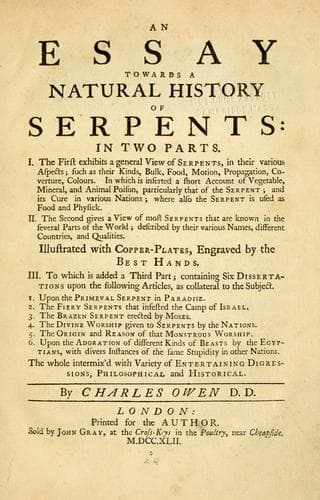
An essay towards a natural history of serpentsOwen, Charles
History
An essay towards a natural history of serpents
Owen, Charles
Serpent worship -- Early works to 1800; Serpents -- Early works to 1800; Serpents -- Religious aspects -- Early works to 1800
CXXIII. _TETZAUCOATL_, or the _rare_ Serpent; so called, because the
_least_ of Serpents; and though very little, scarce four Inches long, or
in Bulk so big as a Goose-quill, yet its Wounds are most deadly. The
Belly is red, and distinguishable by black Stains; the Back yellow,
interlaid with divers Spots. It is an Inhabitant of the North, and
delights in cold Apartments. This (though distinctly described by the
Historian) seems to be the same with the _Tetzaucoatl_[288]. _N. B._
Little Things, greatly dangerous.
Footnote 288:
_Nieremb._
The Poet weeps for a Person killed by the Fall of an Icicle, which is a
little Drop of Water congealed[289]. _Anacreon_, the celebrated Lyrick
Poet among the _Greeks_, was choaked with a _little Kernel_ of a
_Grape_. Little Things do great Executions. Little Worms destroy
floating Castles. _Tarantula_, a little Spider, poisons a Giant. In
_Barbadoes_ is what they call the _Poison-Tree_, a little Drop of its
Sap flying into a Workman’s Eyes, makes him blind; therefore Workmen
cover them with Cypress.
Footnote 289:
Oh! ubi non est si jugulatis aqua.
_Mart._
_PLINY_, from _M. Varro_ says, there was a Town in _Spain_ undermined by
_Conies_, and another in _Thessaly_ by _Mold-Warps_, and another in
_France_, from which they were driven out by Frogs.... In some parts of
_Africa_, People were constrained by _Locusts_ to leave their
Habitations. Out of _Gyaros_ (one of the _Islands_ of the _Cyclades_ in
the _Ægean Sea_, most of which are now under the _Turks_) the
Inhabitants were forced away by _Rats_ and _Mice_, little Things: And if
it be true, that _Theophrastus_ the Philosopher reports, the _Treriens_
were chased away by an Army of little Worms, called _Scolopendra_[290].
All these mighty Conquests were made by little contemptible Insects.
Footnote 290:
_Pliny’s Natural History_, Part I. B. viii. Cap. 29.
What says the _Laconian_, when wounded with a Dart? I am not, quoth he,
concerned at my Death, but at my Fall by a Wound from a little feeble
Archer. For ’tis Satisfaction to the Vanquish’d to die by the Hand of
heroic Valour; hence that of _Virgil_;
_Æneæ Magni dextra cadis....
’Tis by the Great Æneas’ Hand you fall._
The reason was, because the _Lacedemonians_ were wont to fight with
Swords, therefore it was not counted Bravery to kill Men with a Dart, a
thing that may be done by any Woman.
So in the vegetable World, there are _Cedars_ and _Shrubs_. In Natural
Philosophy, we read of _Atoms_, that are _Minima Naturæ_, the ultimate
Particles into which Matter is divisible, and are conceived as the first
Rudiments, or component Parts of all physical Magnitude, or the
pre-existent and incomprehensible Matter, whereof particular Bodies were
formed; there are Mountains and Mole-Hills,
Public-domain text, read in full here on John Shaqi.
Reviews
Reviews
No reviews yet
Be the first to share your thoughts on this work.
Elsewhere in the archive
Join the Discussion
Join the discussion
Sign in to leave a comment or review.
Sign InorCreate an account