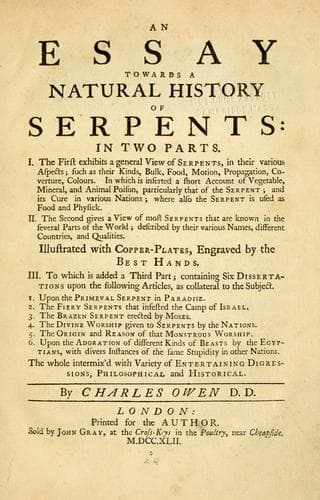
An essay towards a natural history of serpentsOwen, Charles
History
An essay towards a natural history of serpents
Owen, Charles
Serpent worship -- Early works to 1800; Serpents -- Early works to 1800; Serpents -- Religious aspects -- Early works to 1800
This _poetick Griffin_ is frequently seen in antient Medals, and is
still bore in Coat-Armor. The antient and honourable Family of the
_Guillims_ blazons it rampant, alledging any very fierce Animal may be
so blazon’d as well as a Lion. It is observable, says my Author, that in
the Front of _Clayton-hall_ are two Figures drawn in Plaister in the
form of a Coat of Arms; on the right side of the Escutcheon is a Figure
with Wings, four Feet, and a Tail twisted in the Form of a Serpent. The
like Figure is drawn in Plaister in several antient Houses in that
Neighbourhood, which go under the Name of the _Griffin’s Picture_, and
the Sign is used at Publick-houses: There is a Place in that Wood called
the _Griffin’s-Ark_.
_N. B._ This seems to carry some Probability with it, since Eagles are
voracious Creatures, and very destructive to Fawns and Lambs, especially
the black Eagle, which is of a lesser Size than the other.
In some of the _Scots Islands_, the Natives observe, that this Eagle
fixes its Talons between the Deer’s Horns, and beats its Wings
constantly about its Eyes; several other Eagles flying at the same time
on both sides, which puts the Deer upon a continual Run, till it fall
into a Pit, or down a Precipice, where it dies, and so becomes a Prey to
the Enemy[304].
Footnote 304:
_Martin’s Description of the Western Islands of Scotland_, Edit. ii.
p. 7.
CXXXII. In some of the Western Islands of _Scotland_ are several
Serpents: There is one that is _yellow_ with brown Spots, and another
with _brown_ Spots; but that which is the most poisonous, is the _black
and white spotted_, three or four Foot long.
The Remedies are such as these: The Natives cut off the Head of the
Serpent that gives the Wound, and apply it to the Place as the best
Remedy: Others, by the Application of new Cheese, extract the Poison;
and some make use of the Rump of a Cock stript of its Feathers, which
they apply to the Wound with Success, according to the Historian[305].
Footnote 305:
_Martin_’s _Description of the Isle of Skie_, _&c._ p. 236.
In the Library at _Manchester_, is the Skin of a Serpent which was five
Yards long, as thick as the Calf of a Man’s Leg; has a forked Tongue,
scaly Skin, yellow Colour.
Public-domain text, read in full here on John Shaqi.
Reviews
Reviews
No reviews yet
Be the first to share your thoughts on this work.
Elsewhere in the archive
Join the Discussion
Join the discussion
Sign in to leave a comment or review.
Sign InorCreate an account