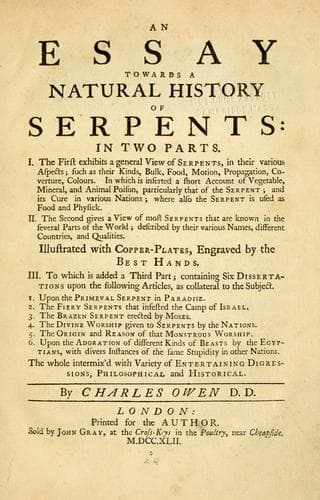
An essay towards a natural history of serpentsOwen, Charles
History
An essay towards a natural history of serpents
Owen, Charles
Serpent worship -- Early works to 1800; Serpents -- Early works to 1800; Serpents -- Religious aspects -- Early works to 1800
V. The _Scolopendra_ is a little venemous Worm, and amphibious. When it
wounds any, there follows a Blueness about the affected Part, and an
Itch over all the Body, like that caused by Nettles. Its Weapons of
Mischief are much the same with those of the Spider, only larger; its
Bite is very tormenting, and produces not only pruriginous Pain in the
Flesh, but very often Distraction of Mind. These little Creatures make
but a mean Figure in the Rank of Animals, yet have been terrible in
their Exploits, particularly in driving People out of their Country:
Thus the Inhabitants of _Rhytium_, a City of _Crete_, were constrained
to leave their Quarters for them[315]. There is a minute _Scolopendra_,
accounted for by Dr. _Molyneux_.
Footnote 315:
_Ælian_, lib. xv. cap. 26.
VI. The _Shrew-Serpent_ in _Norway_, is a Creature of admirable Beauty;
small in Body, and slow in Motion, but of fiery Venom, and its Wounds
most dangerous.
VII. The _Lacertus Facetanus_, or _Tarantula_, whose Bite gives Name to
a new Disease. Those who are wounded by it are denominated _Tarantati_:
It is a kind of an overgrown Spider, about the Size of a common Acorn.
It borrows its Name from _Tarentum_ in _Apulia_, a City in the Kingdom
of _Naples_, built by a Band of _Lacedemonian Bastards_, who having no
Inheritance at home, were sent thither to seek their Fortunes, where
they built that Town, and made it the Capital of _Magna Græcia_.
This little Animal is furnish’d with eight Eyes, and eight Legs: Its
Skin is tender and soft, of various Colours, and always hairy: ’Tis of
the oviparous kind, and propagates its Species by Eggs, and sometimes a
hundred Eggs have been found in one Female.
In the Opinion of some, ’tis not only an Inhabitant of _Apulia_, but
peculiar to that Province, a Situation that may be called, _A Garden of
Rarities_; Plenty of generous Wine, delicate Honey and Oil, an early
Spring, a soft Winter—render it a most delightful Habitation, especially
to old Persons, according to the Poet[316]; and yet in that most
agreeable Region, this little Tyrant reigns and spreads Terror.
Footnote 316:
—Ille terrarum mihi præter omnes—(_Horat._ lib. ii. ode 6.) Angulus.—
Public-domain text, read in full here on John Shaqi.
Reviews
Reviews
No reviews yet
Be the first to share your thoughts on this work.
Elsewhere in the archive
Join the Discussion
Join the discussion
Sign in to leave a comment or review.
Sign InorCreate an account