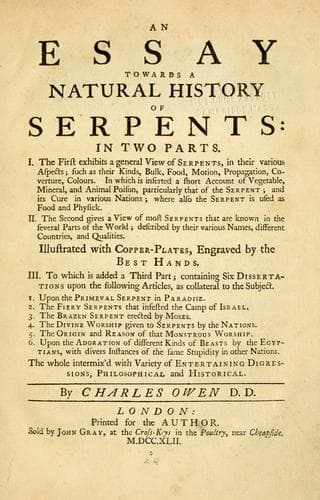
An essay towards a natural history of serpentsOwen, Charles
History
An essay towards a natural history of serpents
Owen, Charles
Serpent worship -- Early works to 1800; Serpents -- Early works to 1800; Serpents -- Religious aspects -- Early works to 1800
The Wound given by any of them is dangerous, and has different
Indications. In some that are bitten, an universal Stupor follows;
others weep: Some tremble and vomit; others laugh, fancying themselves
to be Kings. This perhaps made Dr. _Cornelio_ represent this as an
imaginary Disease; that those who imagine themselves hurt, are most of
our young wanton Girls, who, falling from some particular Indisposition
into Melancholy and Madness, persuade themselves that they have been
stung by a _Tarantula_[319].
Footnote 319:
_Philos. Transact._
Some grow pale, sick and faint, and die in a short time, unless relieved
by Musick, which alone, without the Help of Medicine, performs the Cure.
The Wounded are as Men half dead, but at the first Sound of a musical
Instrument, though they are very weak, and seemingly unable to stir,
they begin by degrees to move their Hands and Feet, till at last they
get up, and then fall to dancing with wonderful Vigour, for two or three
Hours, their Strength and Activity still encreasing. Some will continue
the Dance, without Intermission for six Hours; and when tired they are
put to Bed, and after they are sufficiently recruited by Rest, they are
called up again by the same Tune, and renew the Dance with great
Violence, the Musick still playing; and when the Patients grow weary,
they are put into Bed again, and kept warm to encourage Perspiration.
These Exercises being continued six or seven Days, the Patient finds
himself fatigued and unable to dance any longer, which is the
Characteristic of a Cure.
They usually spend ten or twelve Hours a-day in this violent Exercise,
and continue it for three or four, or six Days; by which time they are
generally freed from all their Symptoms, tho’ not always, says the
learned _Baglivi_, who observes, that about the same time next Year, the
Distemper returns, and will prove fatal, if not prevented by the same
musical Application.
In _Apulia_ is a _Scorpion_, whose Wounds are accompanied with the same
Effects as those produced by the _Tarantula_, and are only curable by
_Musick_ and _Motion_. These _Apulian Scorpions_, are less violent than
those of _Africa_, but more virulent than those in other Parts of
_Italy_. I shall only offer two Remarks here.
1. _THAT different Patients must be entertain’d with different Tunes,
according to the different Symptoms of the Disease_; in which the great
Art of curing them seems to consist. _e. g._ Some are roused by a Pipe,
others by a Timbrel: Some are roused by a Violin, others by the Harp;
and all must be entertain’d with different Airs. The Musicians therefore
make Trial before they can accommodate the _Sound to the Venom_; which
requires the most brisk and lively Tunes, to produce a powerful
Vibration in the Body; and till this be done, the miserable Patients
stand still, sighing and sobbing. The Vibrations must be quick and
frequent.
Public-domain text, read in full here on John Shaqi.
Reviews
Reviews
No reviews yet
Be the first to share your thoughts on this work.
Elsewhere in the archive
Join the Discussion
Join the discussion
Sign in to leave a comment or review.
Sign InorCreate an account