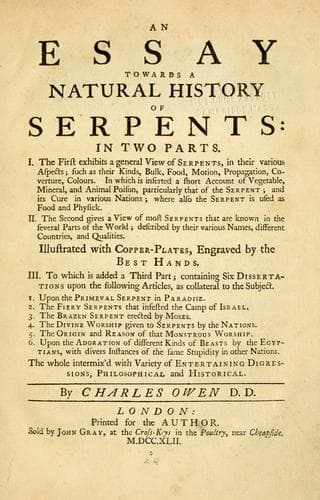
An essay towards a natural history of serpentsOwen, Charles
History
An essay towards a natural history of serpents
Owen, Charles
Serpent worship -- Early works to 1800; Serpents -- Early works to 1800; Serpents -- Religious aspects -- Early works to 1800
That a certain Player on the Flute at _Venice_ had boasted, that by his
playing, he could deprive the Hearers of the Use of their Understanding:
Whereupon he was sent for by the _Doge_, who was a Lover of Musick, and
commanded to put his Art in practice before him; where, after having
play’d some time very finely, (and to the Amazement of the Hearers) he
at last begun a mournful Tune, with a Design, as far as he was able, to
put the _Doge_ into a melancholy Humour; and presently, he struck up a
jovial one, to dispose him to Mirth and Dancing; and after having
repeated these two kind of Tunes several times by turns, the _Doge_
being no longer able to endure those different Emotions, which he felt
in his Soul, he was ordered to forbear playing any longer. _Ibid._ p.
271.
_FROM the Account given of Concords and Discords in Musick, a Reason may
be form’d why two Strings of a Viol, that are Unisons or Octaves one to
another, if one be struck the other will tremble, so as to be visibly
perceived._
_What is this Unison?_ In Musick, _Unison_ is a Consonance of two
Sounds, produced by two Strings, or other Bodies of the same Matter,
Length, Thickness, and Tension, equally struck, and at the same Time, so
that they yield the same Tone or Note. Others define it, _the Union of
two Sounds_, so like each other, that the Ear perceiving no Difference,
receives them as one and the same Sound.
What constitutes Unisonance, is the Equality of the Number of
Vibrations: Unison is the first and greatest of Concords. Others say, it
is only that in Sounds which Unity is in Numbers.
Being once in a Room where there was a _Bass-Viol_, and striking one of
the Strings, a loose Quarry of Glass in the Window, jarr’d every time
that String was struck, which it wou’d not do upon striking any of the
other discordant Strings. The Reason may be, _viz._ That the times of
the Vibration of the loose Quarry, were equal or near Concordance to
those of the String. A Gentleman of my Acquaintance, when he sounded a
particular Tone on the Bass-Viol, very plainly heard the Noise of the
Glass of the Clock in his Chamber, which Glass never moved, upon his
sounding any other Tone.... It is a general Remark, that an
_Unison-String_ will receive the Motion, and so tremble, when another
Unison is made to sound; and yet all other Strings of the same
Instrument, that are not Unisons, shall remain silent and unmoved.
Musick does not only exert its Force on the Passions and Affections, and
musical Instruments, but on the Parts of the human Body also. Witness
the _Gascoigne-Knight_, (mention’d by Mr. _Boyle_) who could not contain
his Water, at the playing of a Bag-pipe: The Woman, mention’d by the
same Author, who would burst out in Tears, at the hearing of a certain
Tune, with which other People were but little affected: And in this
County, near _Rochdale_, there is a certain Man, who can’t forbear
dancing, if in a House, or Market, upon hearing a certain Tune sung.
Public-domain text, read in full here on John Shaqi.
Reviews
Reviews
No reviews yet
Be the first to share your thoughts on this work.
Elsewhere in the archive
Join the Discussion
Join the discussion
Sign in to leave a comment or review.
Sign InorCreate an account