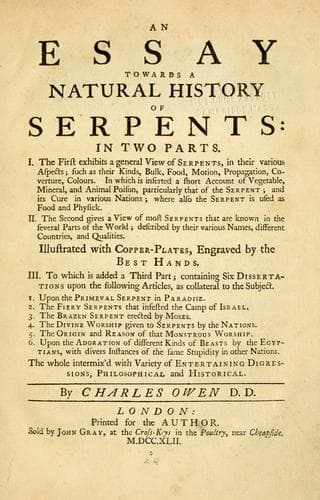
An essay towards a natural history of serpentsOwen, Charles
History
An essay towards a natural history of serpents
Owen, Charles
Serpent worship -- Early works to 1800; Serpents -- Early works to 1800; Serpents -- Religious aspects -- Early works to 1800
Wonder not at the strange Effects of musical Sounds, when other Sounds
strangely affect the Mind. How are the Passions excited by the Sound of
a Drum and the Discharge of Canons.... Not only human Minds and Bodies
are affected by the Impression of Sounds, but even Things without Life.
_KIRCHER_ tells us of a large Stone that would tremble at the Sound of
one particular Organ-Pipe. _Mersenne_ also tells us, of a particular
part of a Pavement that would shake and tremble, as if the Earth would
open, when the Organs play’d. Mr. _Boyle_ adds, that Seats will tremble
at the Sound of Organs, that he has felt his Hat do so under his Hand,
at certain Notes, both of Organs and Discourse; and that he was well
inform’d, every well-built Vault, would answer some determinate Note.
We may observe the like mechanic Perception in several empty
Drinking-Glasses, of fine white Metal. Thus if we cause the Strings of a
musical Instrument to be stretched to a certain Tone or Note, it would
make one of the Glasses ring, and not the other; nor would the Sound of
the same String, tuned to another, sensibly affect the same Glass.
_Morhoff_ mentions one _Petter_, a _Dutchman_, who could break
Rummer-Glasses with the Tone of his Voice. The same, I think, is said of
_Purcel_.
When two Viols are tuned in Unison, one of them being touch’d, the other
will answer, tho’ at some distance. This is a noble Proof of an
harmonious Creation: This Unison looks like a more pure sort of
sympathising that is found in all the Creatures, when those of the same
Species flock together.
Here give me leave to observe, that all Nature is as it were a System of
divine Musick, and delightful Harmony; or, in the sacred Language, a
_Poem_ which is a Work of Skill, curious and polite, lofty and sublime;
in which Numbers and Measures are exactly observed. Under this Idea of a
_Poem_ the old and new Creation are represented.
_THE invisible things of him from the Creation of the World are clearly
seen, being understood by the things that are made_, τοις ποιημασι[332],
Poems that are made. The Creation is, as it were, a _Poem_ in the
Sublime: Every Species of created Beings is a _Stanza_, and every
individual Creature, a Verse in it, as a certain learned Divine
expresses it. Creation here is not stiled εργον, which is a Work of
manual Labor, but ποιημα[333], a Work of Skill; not so much the
Operation of the Hand, as of the Head and Heart: No Creature so small
and mean, but glitters with a Beam of divine Skill.
Footnote 332:
τοις ποιημασι. Rom. i. 20.
Footnote 333:
Αυτου γαρ εσμεν ποιημαι. Eph. ii. 10.
So the new Creation is stil’d a _Poem_.... _We are his Workmanship in
Christ Jesus_, Eph. ii. 10. In the _Greek_, _we are his Poem in Christ
Jesus_.
Public-domain text, read in full here on John Shaqi.
Reviews
Reviews
No reviews yet
Be the first to share your thoughts on this work.
Elsewhere in the archive
Join the Discussion
Join the discussion
Sign in to leave a comment or review.
Sign InorCreate an account