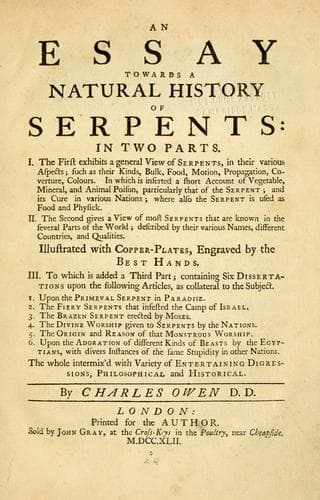
An essay towards a natural history of serpentsOwen, Charles
History
An essay towards a natural history of serpents
Owen, Charles
Serpent worship -- Early works to 1800; Serpents -- Early works to 1800; Serpents -- Religious aspects -- Early works to 1800
In their Extremity, the People addrest their Mediator, Prophet, and
General, _Moses_, saying, _O pray to the Lord that he take away the
Serpents from us!_ The meek Prophet did so; the mediatorial Voice
reach’d Heaven, and mov’d the Almighty who directs _Moses_ to make a
Serpent of Brass, (which was a Figure of the Serpents that plagued the
People) and fix it upon the Top of a Pole, conspicuous to all the
Assembly, promising that all those who were bit by Serpents, and should
look upon this brazen Image, should be presently healed. Astonishing
Clemency! The Event was answerable to this Promise.
This Method of Cure was new and strange; but he who at first called the
World out of nothing, can with equal Facility command Health out of a
Piece of Brass. Another Observable here, is that when the Almighty
refused to hear the Cries of the Wounded in their Distress, he readily
hearkened to _Moses_’s Intercession in their favour. Thus God accepted
the Prayers of _Job_ for his three Friends, when he would not regard the
Supplications they put up for themselves. _Job_ lxii. 7, 8.
----------------------------------------------------------------
SECTION II.
The brazen Serpent was a Figure of the flying Serpent, _Saraph_, which
_Moses_ fixed upon an erected Pole: That there were such, is most
evident. _Herodotus_ who had seen of those Serpents, says they very much
resembled those which the _Greeks_ and _Latins_ called _Hydræ_: He went
on purpose to the City of _Brutus_ to see those flying Animals, that had
been devour’d by the _Ibidian_ Birds.
In _Asiatic-Georgia_, between the _Caspian_ and _Euxine_ Sea, are found
winged Dragons, with anserine Feet and venemous Claws; and some of them
are fortified with more terrible Pedestals than others: their Wings are
generally composed of strong nervous Membranes, which when they walk,
are scarcely visible, because of their close Adherence to their lateral
Parts[358].
Footnote 358:
Paulus Jovius de Piscibus, cap 23. p. 140.
In the _Atlantic_ Caves, and Mountains of _Africa_, is an infinite
Number of these winged Dragons, whose Poison is so strong, that the
Flesh of such as are wounded by them, immediately grows soft, languid,
and incurable[359]. We read of flying Serpents transported from some
Parts of _Arabia_ into _Egypt_[360][361].
Footnote 359:
P. Belon in Johnstonus.
Footnote 360:
Teste Brodæo.
Footnote 361:
J. Leo’s Hist. of Africa, lib. 6, & 9.
These also have been seen in _Florida_ in _America_, where their Wings
are more flaccid, and so weak, that they cannot soar on high. _Scaliger_
describes a certain flying Serpent that was four Foot long, and as thick
as a Man’s Arm, whose Wings were cartilaginous, or gristly, _ibid._
History accounts for one of these flying Dragons that was killed in old
_Aquitania_ in _France_, a Present of which was made to King _Francis_,
as a great Rarity of the Kind.
Public-domain text, read in full here on John Shaqi.
Reviews
Reviews
No reviews yet
Be the first to share your thoughts on this work.
Elsewhere in the archive
Join the Discussion
Join the discussion
Sign in to leave a comment or review.
Sign InorCreate an account