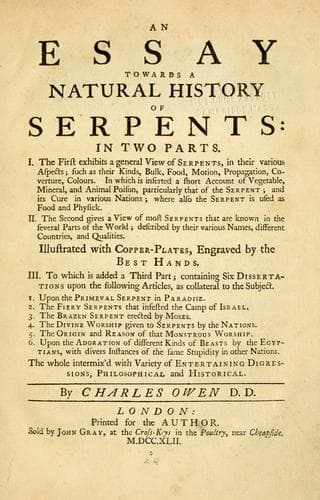
An essay towards a natural history of serpentsOwen, Charles
History
An essay towards a natural history of serpents
Owen, Charles
Serpent worship -- Early works to 1800; Serpents -- Early works to 1800; Serpents -- Religious aspects -- Early works to 1800
Serpents are provided with Tails of different Length and Size; these
also are necessary to adjust their Motion, and guard them against
Stimulation of Flies. In winged Serpents, the Tail serves as a Rudder to
govern them in flying through the Air; and, in the marine Serpents, they
serve as Oars. But another says, the flying of a Bird, in effect, is
quite a different Motion from the sailing of a Ship: Birds don’t vibrate
their Wings towards the Tail, as Oars are struck towards the Stern, but
waft them downward; nor does the Tail of the Bird cut the Air at right
Angles as the Rudder does the Water, but it is disposed horizontally,
and preserves the same Situation what way soever the Bird turns[3].
Footnote 3:
_Borelli._
They are painted with variety of Colours, as red, black, white, brown,
green; the Composition of these, in some of their Garnitures, forms
Beauties exquisitely fine. Some of them have very little Eyes, others
large ones: Some wound with their Teeth, others with the Tail that
terminates in a Sting, which is an Apparatus in the Body of certain
Insects like a little Lance, serving them as a Weapon of Offence.
Mention is made by Historians of harmless Serpents, and of Persons who
have tamed Serpents, and whose Hair has been kissed by a tame Dragon,
and which, with its Tongue, gently lick’d its Master’s Face[4].
Footnote 4:
_Raii Synopsis. Ælian. Hist._
The Serpent seems to be one of the distinguished Favourites of the Air,
seeing it subsists by aerial Food all Winter; that is, in those Regions
where it dare not turn Ranger. Sleep is the Nurse of Nature, a Nurse
that greatly indulges the animal Spirits, and, by arresting voluntary
Motion, prevents their daily Consumption, and, at the same time, allows
the perpetual Motion of the Arteries, Veins, Heart. We know but little
of the real peculiar Nature of what we call Air, only that it is the
most heterogeneous Body in the World, a kind of secondary Chaos, being a
Compound of minute Particles of various Kinds, Earth, Water, Minerals,
Vegetables, Animals, _&c._ collected either by solar or artificial Heat.
These Particles together constitute an Appendage to our Earth, called
Atmosphere; or that thin, elastick, fluid Mass, wherein we live, move,
and have our being; which Air we continually receive, and expel by
Respiration, and no Animal can live, or Vegetable grow without it.
Thus Serpents inclosed in the Receiver, are immediately (I may say)
starved when deprived of Air, which is their only Winter-Food.—_N. B._
Whatever is put in a Receiver so exhausted, is said to be put _in
Vacuo_: Animals that have two Ventricles, and no _Foramen Ovale_, as
Birds, Dogs, Cats, Mice, die in it in less than half a Minute; a Mole
died in one Minute; a Bat lived seven or eight; Insects, as Wasps, Bees,
Grashoppers, seem dead in two Minutes[5].
Footnote 5:
_Derham._
Public-domain text, read in full here on John Shaqi.
Reviews
Reviews
No reviews yet
Be the first to share your thoughts on this work.
Join the Discussion
Join the discussion
Sign in to leave a comment or review.
Sign InorCreate an account