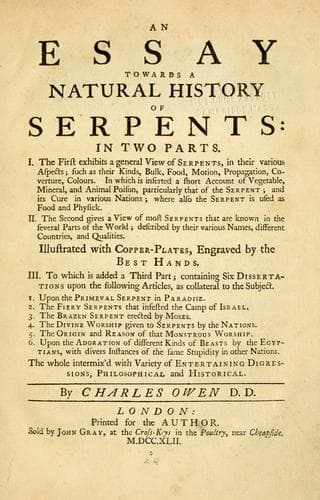
An essay towards a natural history of serpentsOwen, Charles
History
An essay towards a natural history of serpents
Owen, Charles
Serpent worship -- Early works to 1800; Serpents -- Early works to 1800; Serpents -- Religious aspects -- Early works to 1800
From these _Teraphim_ came the _Lares_, or the Household Gods of the old
_Romans_, who before the Laws of the Twelve Tables, used to bury the
Dead in their Houses; from whence arose that great Veneration they had
for their _Lares_ and _Penates_, a kind of domestick Divinities,
worship’d in Houses, and esteem’d Protectors of Families, which were
nothing else but the supposed Ghosts of those who formerly had belonged
to the Family, whom they represented by Images, which they placed in the
Chimney-Corner, or near their Doors.
These were also look’d upon as Guardians of the Highways, near to which
their Images were fix’d for the Benefit of Travellers, therefore call’d
_Dii Viales_, Gods of the Roads. ’Tis said by the Prophet, _The King of
Babylon stood at the parting of the Way_, and consulted _with the
Images_; with the _Teraphim_, says the _Hebrew_, _Ezek._ xxi. 21. which
the _Jewish_ Interpreters say were prophetick Images, endued with the
Gift of Prediction; so far from being mere Idols, that they gave out
Oracles, and foretold Things to come.
Some think _Laban_’s _Teraphim_ to be such, and that _Rachel_, having
observed how her Father did divine by them, and fearing, by consulting
with them, he might know which way _Jacob_ went, and follow after and
murder him; to prevent so fatal a Catastrophe, she took away his
_Oracles_.
Those sacred Images might, at first, be made in honour of departed
Relatives, or illustrious Persons; but by degrees degenerated into
religious Adoration. Thus the _Manes_ of the Dead were worship’d by them
under the Figure of their _Teraphim_, in some place of the House, and
probably where they had deposited the Remains of their Ancestors, as
some think.
The _Lares_ were also called _Penates_: To these they paid religious
Homage with Sacrifices; so the _Roman Satirist_ says, and calls these
images his _dear little House-Gods_; and then observes, that they were
crown’d with Garlands of Flowers in Summer, and in Winter with Shaving
of Horns colour’d. To these _Waxen-Gods_ the _Romans_ addrest themselves
with Offerings of Frankincense and Cakes[372]....
Footnote 372:
Oh parvi nostrique Lares quos thure minuto
Hic nostrum placabo, Jovem Laribusque paternis
Thura dabo, atque omnes violæ jactabo colores
Cuncta nitent——
_Juvenal. Sat._ ix. _v._ 137. & _Sat._ xii. _v._ 89.
They were supposed to be the Spirits of such, who had lived well on the
Earth, and in consequence of it, were happy; so on the other hand, those
who lived ill here, did after Death wander up and down in Horror, and
were supposed, by the Vulgar, to be Hobgoblins, call’d _Lemures_, _i.
e._ restless Ghosts of departed Spirits, who return to the Earth to
terrify the Living.
Public-domain text, read in full here on John Shaqi.
Reviews
Reviews
No reviews yet
Be the first to share your thoughts on this work.
Elsewhere in the archive
Join the Discussion
Join the discussion
Sign in to leave a comment or review.
Sign InorCreate an account