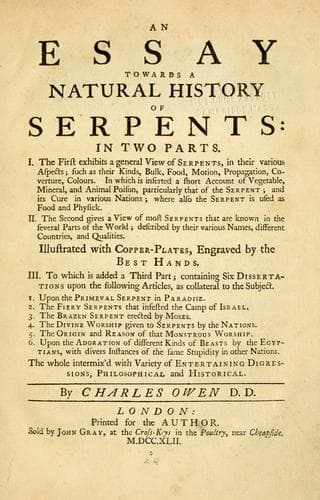
An essay towards a natural history of serpentsOwen, Charles
History
An essay towards a natural history of serpents
Owen, Charles
Serpent worship -- Early works to 1800; Serpents -- Early works to 1800; Serpents -- Religious aspects -- Early works to 1800
The King of _Calicut_ (in the _East-Indies_, the most powerful of all
the _Malabar_ Princes) causes little Cottages to be erected for sacred
Serpents, to guard them against the Inclemency of the Weather, and ’tis
made Death to hurt them, being they are look’d upon as heavenly Spirits;
and they believe them to be such for this Reason, because _they kill Men
so suddenly by the Wound they give, which is only a little Puncture, and
would not prove fatal if given by other Creatures_.
It is observed by some, that Serpents at this day are highly honour’d in
the Kingdom of _Calicut_, on this side the _Ganges_, where the
Inhabitants call their King _Samori_, or _Zamorin_, that is, Sovereign
Emperor, and God upon Earth. The Dragon being a Serpent of the vigilant
Tribe, was constituted and made Guardian of their Houses, of their
oracular Temples, and of all their Treasures.
These Protectors of Places and Possessions, they call’d Tutelary Gods,
and were worshipp’d by them under the Symbol of _Serpents_, without
whose Sanction no Methods of Protection were available.
It is remarkable, that where the Figure of two Serpents was erected in
any place, it was look’d upon as a Sign of consecrated Ground; that is,
that the Place was holy, being dedicated to some God; for which
Superstition they are ridiculed by one of their own Writers, _viz._
_Persius_ the Satirist, that lived under _Nero_, who tells us, that
Children were forbid to empty themselves in those Places, and not so
much as make-water, for the Place is holy, as appears by the _Picture of
the two Serpents_; the Language of which is, Profane not holy Ground.
Would you, Sir, have your Poem pass for a sacred Composure, then paint
two Serpents in the Front of it.
Behold here the Original of that Popish Superstition, which forbids Men
to make-water in the Church-Yard[398].
Footnote 398:
Pinge duos angues, pueri, sacer est locus, extra
Meite——
_Satir._ i.
At _Alba_, in a Wood not far from _Juno_’s Temple, is a Dragon
worshipp’d by the Inhabitants, and for their greater Honour, fed by
Virgins, thereby intimating, that Innocence was a proper Attendant on
the Gods.
In _Epirus_, south of _Macedonia_, is a certain place sacred to
_Apollo_, and wall’d about, within which are kept _sacred Dragons_, fed
likewise by a Virgin Priestess, uncloathed, which they believe to be
most acceptable to their idol Gods[399]; called by _Juvenal_, one of
their own Poets, _wenching Gods_.
Footnote 399:
Ælian. lib. ii. cap. 2. ἱερεια γυμνη παρθενος.
The _Epiroticks_, who highly venerated _Apollo_, honour’d his Temple
with a _consecrated Dragon_, which they worshipp’d in solemn remembrance
of his killing the _Pythonic Serpent_. It were well if the same Spirit
of Gratitude reign’d amongst _Britons_, towards the Heroes that
deliver’d their Country from the great Ecclesiastical Dragon, by the
glorious Revolution.
Public-domain text, read in full here on John Shaqi.
Reviews
Reviews
No reviews yet
Be the first to share your thoughts on this work.
Elsewhere in the archive
Join the Discussion
Join the discussion
Sign in to leave a comment or review.
Sign InorCreate an account