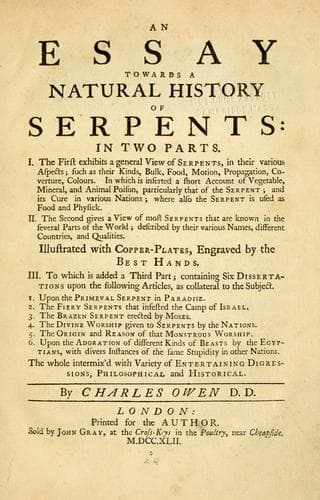
An essay towards a natural history of serpentsOwen, Charles
History
An essay towards a natural history of serpents
Owen, Charles
Serpent worship -- Early works to 1800; Serpents -- Early works to 1800; Serpents -- Religious aspects -- Early works to 1800
Near _Lavinium_ was a Grove of serpentine Gods, dedicated to _Juno_ of
_Argos_, which was a City in _Peloponnesus_ (famous for the Shrine of
_Æsculapius_) now the _Morea_, one of whose Rivers is called _Styx_; or
rather a Well, whose Water is so cold and venemous, that it often kills
such that drink thereof; and therefore design’d by the Poets, to be a
River of Hell: ’Tis said by some, that _Alexander_ was poison’d with it.
It’s well known what Worship was paid to the Serpent at _Epidaurus_, a
_Peleponnesian City_, and the Manner how ’twas pretended that Serpent
was brought to _Rome_, which is as follows, _viz._
The _Romans_ being sorely distrest by a Plague, they sent a _Galley_
with Ambassadors to _Epidaurus_, to bring the Serpent consecrated to
_Æsculapius_ to _Rome_, which of its own accord went aboard the Galley,
and which was landed in the Isle of _Tyber_, where divine Honours were
paid to it; upon which the Plague ceased.——Take it as represented by the
Historian, who says, ... That the Plague raging terribly at _Rome_, and
in the Vicinity, above three Years, did not abate, by any divine or
human Remedy, tho’ Men had tried both; therefore by the Counsel of the
_Delphic Oracle_, ten Ambassadors were sent to fetch the Statue of
_Æsculapius_, that was ador’d in the Body of the great Serpent;
hereupon, a very strange thing ensued, and manifestly true, both from
many faithful Historians, and building the _Temple_ (dedicated to it) in
the _Isle of Tyber_.
When the _Roman Ambassadors_ had delivered their Commands to the
_Epidaurians_, who brought them into the Temple of _Æsculapius_ ...
while they were admiring a huge Shrine, a great Serpent sliding of a
sudden from the _Adytum_ (which was a Place of Retirement in the Pagan
Temples, where Oracles were given, into which none but Priests were
admitted) upon sight of it the Priests, in a devout Posture, said to the
Company, _that the Deity shrouded itself in that Form_, and when it
appear’d in this _Fashion_, ’twas look’d upon as a _happy Omen_.
The Serpent was seen for two Days in the Temple, and afterwards
disappeared, but on the third Day it past thro’ the Croud (which gazed
on and worship’d) and went directly to the Port where the _Roman Galley_
stood; and having enter’d into it, laid itself down in the Cabin of _Q.
Ogulnius_, the chief Ambassador. They set sail from thence ... and soon
arrived at _Rome_. The whole City came out to see this wonderful
Thing——Altars were built, Incense burnt, and Sacrifices offer’d. The
Serpent swam over to the _Isle of Tyber_, (which afterwards was called
_Æsculapius_’s _Isle_) and since was never seen.
The Senate concluding this Island to be the Place chosen by the God,
decreed that a Temple should be built for _Æsculapius_ there—whereupon
the Plague ceased. The Temple grew famous for rich Offerings, in
Consideration of their Deliverance from the Plague by that Deity[400].
Footnote 400:
Public-domain text, read in full here on John Shaqi.
Reviews
Reviews
No reviews yet
Be the first to share your thoughts on this work.
Elsewhere in the archive
Join the Discussion
Join the discussion
Sign in to leave a comment or review.
Sign InorCreate an account