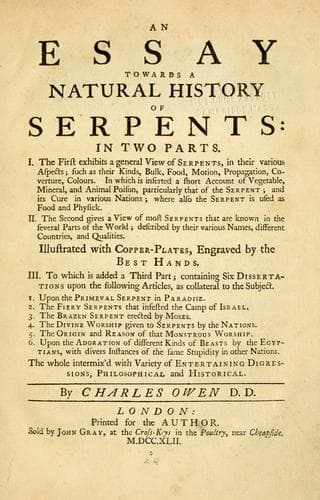
An essay towards a natural history of serpentsOwen, Charles
History
An essay towards a natural history of serpents
Owen, Charles
Serpent worship -- Early works to 1800; Serpents -- Early works to 1800; Serpents -- Religious aspects -- Early works to 1800
II. The _Amodytes_ is a Serpent very venemous and fierce, of a sandy
Colour, black Spots, and of about a Cubit long. The Wound given by the
Female, the weaker Vessel, is said to be most dangerous: Its Jaws are
larger than the common Vipers, and from some Eminencies upon the Head,
like a Tuft of Flesh, is called _Cornutus_. Its Wounds prove fatal
without a speedy Cure. It is found in _Lybia_, a Limb of _Africa_, and
also in _Illyricum_, and in some parts of _Italy_[103].
Footnote 103:
_Comitatu imprimis Goritiensi invenitur._—_Ray._
This Serpent is called _Cornutus_, a horned Beast[104]. Of this Form, is
a numerous Herd; we read, that in the _Roman_ Army was a Band of Foot
Soldiers called _Cornuti_.
Footnote 104:
_Lucan. Pharsal._ lib. ix.
Upon the Continent of _America_ are Bulls and Cows, that have no Horns,
says Dr. _Ch. Leigh_——who adds,
“The Defect of _Horns_ in these Beasts, brings into my mind a
remarkable Phenomenon of one _Alice Green_, whose Picture I have
seen in _Whalley-Abby_, in _Lancashire_. This Woman had _two
Horns_ which grew out of the back-part of her Head; they grew
backwards like those of Rams, and were about three Inches long;
these she cast once in three Years, and had always intolerable
Pains, before the Horns broke out[105].”
Footnote 105:
His _Natural History of Lancashire_, Book ii. p.3.
He might have mentioned another innocent Creature, on whose Head a
treacherous Companion inoculates a Scion, which intitles him to the
Title of Cuckold, a word derived from _Cuckows_, who having no Beds of
their own, invade their Neighbour’s. Of the _Cuckow_ ’tis said, that
having no Nest, she takes possession of some other Bird’s Nest, destroys
the Eggs, and lays in it an Egg of her own, which the innocent Bird
brings forth and nurses for its own[106].
Footnote 106:
Dr. _Willoughby_, who writ the History of Birds, affirms this Account
of the Cuckow to be true upon his own Knowledge, according to Mr.
_Ray_.
III. The _Cerastes_ is a Serpent of the viperine Kind; its Head
resembles the _Cornigerous_; it belongs to the _Libyan_ and _Nubian_
Family: Its Teeth are like those of the Viper, and it brings its
Successors into the World after the same manner.
Its Constitution is very dry, which refines and exalts its Poison, and
makes it more dangerous; the Wound is generally attended with
Distraction, and continual pricking as with Needles. Some say, ’tis of a
whitish Colour, others arenaceous; it loves sandy Habitations, where it
often surprises the unwary Traveller: And all agree ’tis of a most cruel
Nature; and therefore in some Places ’twas made the Executioner of
Malefactors[107], as the Juice of the _Cicuta_, (an Herb like our
_Hemlock_) was among the _Athenians_.
Footnote 107:
_Nunc potes actutum insidiatoremque Cerasten—Non is corpus habet, sed
quatuor aut duo profert Cornua._ Nicander in Ther.
[Illustration:
_Plate 1^{st}_
]
Public-domain text, read in full here on John Shaqi.
Reviews
Reviews
No reviews yet
Be the first to share your thoughts on this work.
Elsewhere in the archive
Join the Discussion
Join the discussion
Sign in to leave a comment or review.
Sign InorCreate an account