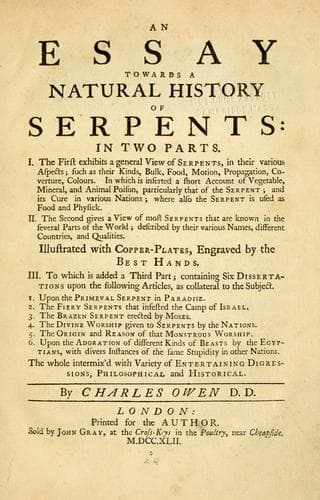
An essay towards a natural history of serpentsOwen, Charles
History
An essay towards a natural history of serpents
Owen, Charles
Serpent worship -- Early works to 1800; Serpents -- Early works to 1800; Serpents -- Religious aspects -- Early works to 1800
They differ in external Form: The _Draconopades_ are represented by a
human Face, and sightly Countenance; the rest of the Body in a tortuous
winding Shape. In one of Dr. _Johnson_’s Figures, a Dragon is made to
appear like a Man’s Face, with a Grenadier’s Cap on the Head. Some
differ in Colour, some are black in the upper Part of the Body,
according to _Philostratus_; red, according to _Homer_; yellow,
according to _Pausanias_; and _Lucan_ makes it a golden Colour[150].
Footnote 150:
_Philostratus de Vita Apol._ lib. iii. cap. 2. _Homer._ _Iliad_, lib.
12. _Lucan._ _Pharsal. in Jonstoni Historia Serpentum_, p. 33, 34.
The same Historian observes, that in the _Atlantick_ Mountains, they
kill where they touch, and those that are in the Kingdom of _Narsinga_,
and dwell in the Woods, kill all they meet. _Ibid._[151]
Footnote 151:
_Unde quidam in arbores & chamo dracones distinxere._
I presume, the Author means _Narsinga_, a potent Kingdom, bounded on the
East with the Bay of _Bengal_, that noble Part of _India_, says
_Herbert_[152]; where the Monarch is always attended with 1000 for his
Guards, has 5 or 6000 Jesters, and reckons it one of his chief Titles to
be the Husband of a Thousand Wives.
Footnote 152:
His Travels into _Africa_ and _Asia_, the famous Empires of _Persia_
and _Indostan_,—Oriental Islands.
Dragons are Inhabitants of _Africa_ and _Asia_; those of _India_ exceed
most in Largeness and Longitude: In the Tower of _London_, is the Skin
of one, which is of vast Bulk. In _Æthiopia_, they have no Name for
_Dragons_, but _Killers of Elephants_, which is supposed to be the
largest of Land-Animals.
Over the Water-gate in the City of _Rhodes_, there is set up the Head of
a _Dragon_, which was 33 Foot long, that wasted all the Country, till it
was slain by _Deodate de Gozon_, one of the _Knights of St. John
Baptist_[153]. The _Knights of that Order_ had frequently attack’d it,
but in vain; for its Scales being proof against all their Arms, it
destroyed so many of them, that the Grand-Master forbad them to engage
the Monster any more.
Footnote 153:
_Atlas Geog. Anatolia_, p. 43, -4. From _Tavernier_ and _Du Mont._
Public-domain text, read in full here on John Shaqi.
Reviews
Reviews
No reviews yet
Be the first to share your thoughts on this work.
Elsewhere in the archive
Join the Discussion
Join the discussion
Sign in to leave a comment or review.
Sign InorCreate an account