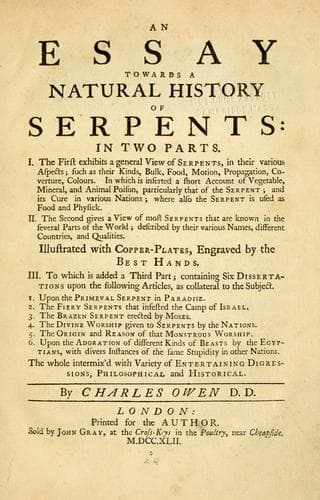
An essay towards a natural history of serpentsOwen, Charles
History
An essay towards a natural history of serpents
Owen, Charles
Serpent worship -- Early works to 1800; Serpents -- Early works to 1800; Serpents -- Religious aspects -- Early works to 1800
This Serpent is found in the _Lybian Deserts_, and also in the Island of
_Lemnos_, in the _Ægean_ Sea. The Puncture made by its Wounds is so
small, that it can scarcely be discerned, yet terminates in a dreadful
Inflammation and a lingering Death.
_ERASMUS_ was puzzled about the Sense of that _Greek_ Proverb ὑδρος εν
φιθω, _hydrus in dolio_, a Serpent in the Hogshead: The Meaning of it,
said an Interpreter of Dreams, is this: A certain Person had a Vessel of
Wine, that was constantly diminishing, tho’ carefully lock’d up; the
Reason of which he could not account for, till he empty’d the Vessel, at
the bottom of which he found a Serpent rioting in Wine[148].
Footnote 148:
_Conradus Gesner._
Perhaps as good an Interpretation may be this, that there was Venom in
the Cask (of which the Serpent was an Emblem) to all those who rioted in
the Bowls of Excess. Not so, says a Son of _Bacchus_; for
_The thirsty Earth soaks up the Rain,
And drinks, and gapes for Drink again.
The Sea itself, which one would think,
Should have but little need of Drink,
Drinks Ten thousand Rivers up._——
_The busy Sun, and one would guess
By’s drunken fiery Face no less,
Drinks up the Sea.——
Fill up the Bowl then, fill it high,
Fill all the Glasses there, for why,
Should every Creature drink, but I?
Why, Man of Morals, tell me why?_[149]
Footnote 149:
_Cowley_’s Anacreon.
Some of the Poets have thought this _Amphisbæna_ to be the _Hydra
Lernæa_, the many-headed Serpent, that was very terrible to the adjacent
Country, and slain by _Hercules_: When one Head was cut off, many others
sprung up; so that there was no way to destroy the Monster, but by
cutting off all the Heads with one Stroke.
Tho’ there be no _Amphisbænick_ Animals, there is some Resemblance of it
in Plants, whose _Cotyledon_ is always double, and in the common Centre
of the two, is a Point or Speck, which is the Plantule, or the Tree in
Embryo; which Plantule being acted on by the Earth, warmed by the Sun,
begins to expand, and shoots its Root both upward and downward. Thus, in
a Bean committed to the Ground, we soon see it to cleave into two Parts,
and in the Fissure appears a little Speck, which sends out a Root
downwards, and a Bud upwards.—A remarkable Phænomenon, says the Note on
_Boerhaave_’s Theory.
X. Among Serpents, Authors place _Dragons_; Creatures terrible and
fierce in Aspect and Nature. They are divided into _Apodes_ and
_Pedates_, some with Feet, and some without them; some are privileged
with Wings, and others are destitute of Wings and Feet: Some are covered
with sharp Scales, which make a bright Appearance in some Position. Some
have observed, that about the _Ganges_, are Dragons whose Eyes sparkle
like precious Stones.
Public-domain text, read in full here on John Shaqi.
Reviews
Reviews
No reviews yet
Be the first to share your thoughts on this work.
Elsewhere in the archive
Join the Discussion
Join the discussion
Sign in to leave a comment or review.
Sign InorCreate an account