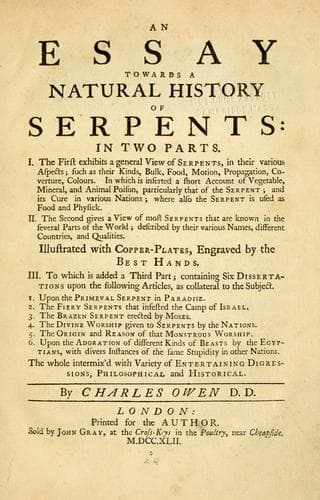
An essay towards a natural history of serpentsOwen, Charles
History
An essay towards a natural history of serpents
Owen, Charles
Serpent worship -- Early works to 1800; Serpents -- Early works to 1800; Serpents -- Religious aspects -- Early works to 1800
XIII. The _Cæcilia_ or _Typhlinus_, the blind Worm, as the _Greek_ word
imports; not that it wants Eyes, but because they are so little, that he
must be furnish’d with good Optics that can discern them: And the Ear
also is as remarkably dull, therefore call’d by the _Greeks_
κωφιας[160]; of a brown Colour, full of Spots, variegated: The Belly is
blackish, the Neck sky-colour’d, garnish’d with certain black Spots:
Head like a Lamprey, and is as free from Poison: Little Teeth, a forked
Tongue, and may be handled without hurt[161].
Footnote 160:
_Quasi surdaster, quod hebetis sit auditus._
Footnote 161:
_Nicander_ calls it απημαντον, quod nullam noxam inferat. _Jonstonus_,
p. 19.
This Serpent seems to resemble those People which we call _Myops_, _i.
e._ Mouse-eyed, or purblind, which happens when the Eye is so _convex_,
that the Rays of Light unite, before they come to the _Retina_, which
makes the Eye also look small, whence the Name[162].
Footnote 162:
From τυφλοω excæco, κωφοω, exsurdo.
The _Cæcilian Serpent_ is about a Foot long, and distinguishable from
our common Serpents by the Form of its Body, which is almost of the same
Crassitude, excepting two or three Inches at the extremity of the Tail.
_Conradus Gesner_ tells us, his Wife struck one of these Serpents on the
Head, when ’twas pregnant, and it immediately cast forth its young[163].
Footnote 163:
_Gesner_, p. 36. _Ælian._
XIV. The _Cencris_, or _Cencrina_ is a spotted Serpent, and very
venemous; denominated from _Milium_, a small Grain call’d Millet-feed;
to which Historians compare the Spots wherewith this Serpent is adorn’d:
For the same reason, a certain Species of the _Herpes_, that is, a
cutaneous Distemper, which is a kind of spreading Inflammation, (and is
like Millet-feed on the Skin) is called _Miliary_: And by some, this is
called the _Miliary Serpent_[164].
Footnote 164:
_Ab aliquibus Miliaris appellatur._ Jonstonus, p. 20.
This Serpent is compared by _Nicander_ to a _Lion_; either for _Cruelty_
in thirsting after Blood, or for its _Courage_, which appears in all its
Attacks. How furious in all its Wars, offensive and defensive! always
fighting, Lion-like, with an _erected Tail_: Which leads me to a
Digression about the _Turkish Standard_, which is a _Horse-Tail
erected_: The Original of that Custom was this, _viz._ One of the
_Turkish Generals_ having his Standard taken in a Battle with the
_Christians_, and perceiving his Men discouraged by the loss of it, he
cut off a _Horse-Tail_, and fastening it to the top of a _Half-pike_,
advanced it on high, crying out, _This is the great Standard, let those
that love me follow it_: Upon which his Men rallied, fought like
_Lions_, and obtained the Victory[165].
Footnote 165:
_Tavernier._
Public-domain text, read in full here on John Shaqi.
Reviews
Reviews
No reviews yet
Be the first to share your thoughts on this work.
Elsewhere in the archive
Join the Discussion
Join the discussion
Sign in to leave a comment or review.
Sign InorCreate an account