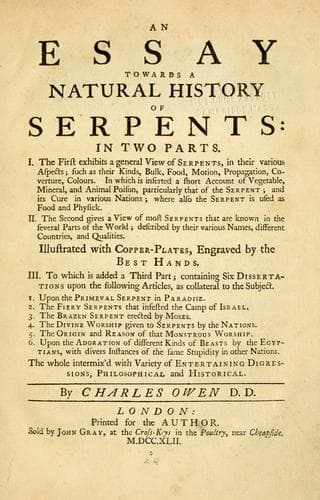
An essay towards a natural history of serpentsOwen, Charles
History
An essay towards a natural history of serpents
Owen, Charles
Serpent worship -- Early works to 1800; Serpents -- Early works to 1800; Serpents -- Religious aspects -- Early works to 1800
But to return to the Serpent, which moving in a direct Line, goes fast,
but being of great Bulk, can’t suddenly wind about[166]: Circumvolution
is the way to avoid its Menaces. ’Tis commonly found in the Island of
_Lemnos_ (the old _Dipolis_, and now the _Stalimene_ of the _Turks_) and
also in _Samothracia_, an Island in the _Archipelago_, a Province
anciently famous for the _Dii Cabiri_, that is, _certain Gods_
worshipped by the _Samothracians_ and _Phenicians_, and had in such high
Veneration, that it was a Crime to mention Names so sacred among the
People[167]. Some say they were God’s Ministers, others think they were
Devils.
Footnote 166:
_Et semper recto lapsurus limite cencris._ Lucan. Pharsal. p. 269.
Footnote 167:
_Bochart Geogr. Sacra_, lib. i. cap. 12.
XV. The _Acontia_[168], called by the _Latins_, _Serpens Jacularis_, and
by some, the Flying Serpent, because of the Celerity of its Motion. In
_Lemnos_ ’tis call’d _Sagittarius_, the Bowman or Archer. By the modern
_Greeks_, _Saeta_, a Dart; for it flies like an Arrow at its Prey[169].
A certain Person in _Cato_’s Army call’d _Paulus_, was slain, not by the
Poison, but the Violence of its Blow[170]: Probably on the lateral part
of the Scull.
Footnote 168:
Απο του ακοντος, quod, jaculi instar, se vibret.
Footnote 169:
Rumpat & Serpens iter institutum
Si per obliquum similis sagittæ
Terruit mannos.
Footnote 170:
——immisit (jaculum vocat Africa,) serpens
Perque caput Pauli transacta tempora fugit
Nil ibi virus egit: rapuit cum vulnere fatum.
_Lucani Pharsalia_, lib. ix. p. 273.
Authors are not agreed about its Dimensions. _Ambrosinus_ speaking of
one he had seen in the _Bononian Musæum_, says, ’tis about the thickness
of a Staff, and about three Foot long: It is found in _Egypt_, its
Wounds are dreadful, being attended with Putrefaction and Defluxion of
the Flesh.
That which _Bellonius_ saw, was three Palms long, or sixteen Inches and
a Finger’s Breadth. _N. B._ _Palmus_ stands for two different Measures;
_Palmus major_ contains twelve Fingers; _Palmus minor_, four Inches.
It lies in wait under Bushes, from whence it rushes out unawares, and
flies like an Arrow at Passengers: Before it leaps at the Prey, it lies
on the Ground, and turns itself round, to give the greater spring to the
Motion, by which she’ll do execution at twenty Cubits distance[171].
Footnote 171:
_Jonstonus_, p. 20, 21.
These nimble Leapers are found among the _West-Indians_, especially in
_Hispaniola_, where there are little Serpents in green Apparel, that
hang by the Tail on the Branches, from whence they suddenly leap upon
their Prey. Among the _Sabæans_ are some cloathed in red, four Inches
long, that thus leap upon Men unawares; and hurt, not only by striking,
but touching.
Public-domain text, read in full here on John Shaqi.
Reviews
Reviews
No reviews yet
Be the first to share your thoughts on this work.
Elsewhere in the archive
Join the Discussion
Join the discussion
Sign in to leave a comment or review.
Sign InorCreate an account