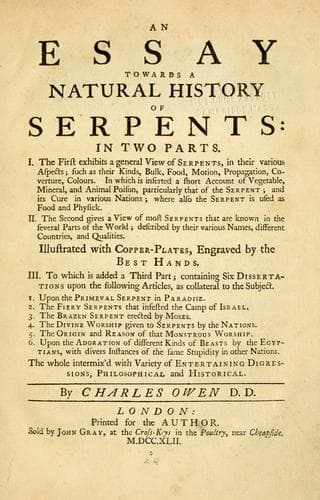
An essay towards a natural history of serpentsOwen, Charles
History
An essay towards a natural history of serpents
Owen, Charles
Serpent worship -- Early works to 1800; Serpents -- Early works to 1800; Serpents -- Religious aspects -- Early works to 1800
Though they propagate as Vipers, it does not appear that they sit on
their Eggs, as most oviparous Animals do; for we often find a Brood of
young Serpents in old Hedges and Dunghills, and no visible Sign of a
common Passage to and from the Nest.
XXI. The _Elephantia Serpents_ are those whose Wounds cast People into a
Leprosy or Roughness of Skin, like that of an Elephant: Hence Leprosy
proceeding from inward Disorders, is call’d _Elephantia_ or
_Elephantiasis_, which is a cutaneous Disease, makes the Skin scurfy and
rough, in Colour resembling that of an Animal, that in Bulk and
Intelligence is superior to all four-footed Beasts.
_Elephants_ in _India_ are said to be about 12 Foot high, and of a
Mouse-colour, the Skin not only rough, but hard, so hard, that it is not
penetrable by a Sword; their Eyes like those of Swine; two Teeth hang
out beyond the rest, which are Ivory.
A memorable Instance of this gigantick Creature’s Understanding, we had
a few Years ago at _Newcastle_ in _Staffordshire_, where a Man
travelling with an _Elephant_ for a Show, one Morning conducting that
Creature to water, happened to pass by a Taylor’s Shop, that was working
at an open Window, and so near it, that the _Taylor_ had the _Courage_
to prick him with his Needle: The Beast did not then seem to resent the
Affront, but when he returned from the Water, which he having artfully
muddled, took into his Trunk; as he came back by the Taylor’s Window,
spouted it in his Face, which very much disobliged a Piece of
Scarlet-cloth on his Table.
[Illustration:
_Plate 4^{th}._
]
That Elephants are subject to Wrath and Revenge, is evident from other
Instances: _e. g._ We read of an Elephant, that when he was brought into
a certain Theatre, saw, as he pass’d along, a Keeper of wild Beasts,
sitting in the Market-place, whom he suddenly killed: And that the
occasion of this Revenge was, because the said Keeper about ten Years
before had struck him with a Sword in that same Place[185].
Footnote 185:
_Michael Glycas_’s Annal. par. 1. in the Memoirs of the Royal Society,
vol. v, vi. p. 280, 281. _ibid._ p. 281.
And _Acosta_ writes, that a Soldier in the Town of _Cochine_, had thrown
the Kernel of a Nut at an Elephant, which the Animal took up and
carefully hid: Some Days after, the Elephant seeing the said Soldier
pass by, threw it in his Face, and went away leaping and dancing.
_Ibid._
In that same Town, another Soldier, meeting an Elephant and his Keeper,
would not give way to them: Whereupon the Keeper complained to the
Elephant of the Affront, who some days after, standing on the River
_Mangata_, which runs through the Town, and seeing that sturdy Soldier
stand idle, ran hastily towards him, lifted him upon his Trunk, and
plunged him several Times in the River; after which, he drew him out,
and left him where he found him. _Ibid._
Public-domain text, read in full here on John Shaqi.
Reviews
Reviews
No reviews yet
Be the first to share your thoughts on this work.
Elsewhere in the archive
Join the Discussion
Join the discussion
Sign in to leave a comment or review.
Sign InorCreate an account