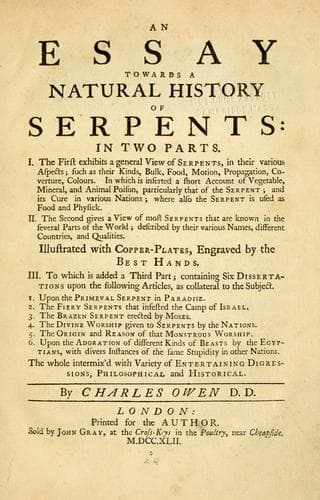
An essay towards a natural history of serpentsOwen, Charles
History
An essay towards a natural history of serpents
Owen, Charles
Serpent worship -- Early works to 1800; Serpents -- Early works to 1800; Serpents -- Religious aspects -- Early works to 1800
XIX. The _Dipsas_ or _Dipsacus_ is a little venemous Reptile of the
Aspick kind[181], less than a Viper, but kills sooner; and is most
remarkable in this, that when it bites, the Poison brings an
unquenchable Thirst on the Person affected, who finding no Relief, runs
to the Water, and drinks till he bursts asunder[182].
Footnote 181:
Some make it of the viperine Sort. One calls it, _Vipera siticulosa.
Vipera sitem facientes._ Avicenna. Conrad. Gesner, p. 42. _Inter
aspidem & viperam_, says another. _Ibid._
Footnote 182:
_Accessio Gyllii_, cap. 47.
The Poetick Historian observes, how _Aulus_, an Ensign-bearer in the
_Roman_ Army in _Africa_, was slain by this Serpent; at first he felt
little or no Pain from the Bite, but as soon as it began to operate, he
was immediately scorch’d to death[183]. _Galen_ calls this Serpent
_Diabetes_, and _Ægineta Dipsacus_, from the incurable Thirst that
accompanies its Bite: By others ’tis called _Situla_, because of the
burning Heat caused by the Wound.
Footnote 183:
——_Sanguinis Aulam.
Torta caput retro Dipsas calcata momordit.
Vix dolor_—— p. 270.
It is about a Cubit in Length, lives in salt Marshes and shallow Waters;
it dwells in _Arabia_, _Rhodes_, _Africa_, especially in _Lybia_, where
some Branches of the venemous Family live on Camel’s Flesh, and Locusts
dried in the Sun. The more hot the Climate, the more terrible the Wound,
as it is in that hot Country, where they have no Springs, but a few salt
Wells, which increase the animal Appetite of Thirst. The learned
_Venetian_ makes the Serpent _Dipsas_ an _Hieroglyphick of illicit
Love_, the Poison of which will, without timely Repentance, excite the
Thirst of _Dives_, who wanted a Drop of Water to cool his scorched
Tongue[184].
Footnote 184:
_Joannis Pierii Valeriani Bellunensis Hieroglyphica, inter
Collectanea_, p. 34. _Titulus_, _Amoris ignes_.
XX. _Common Snake._ These Serpents in their Summer-rambles haunt among
Bushes, mossy Grounds, uliginous and unfrequented Situations. In a
sultry Day they may be seen basking themselves in the Sun, near their
Apartments: The Sight of a Person puts them to flight; and upon a close
Pursuit of them, they make a Stand, raise up their Heads to a
considerable Height, and oppose the Enemy with a loud and angry Hiss. No
Danger is apprehended from their Bite, and they are handled with
Impunity.
This Species of Serpents resembles the _Esculapian_, that has been fed
in some Families; and when provoked to use the Teeth, the Danger is no
more than that from a Bee, whose Weapons are defensive, and not employed
without Provocation: In Winter they retire into subterraneous Spaces,
where they lie dormant, till the vernal Sun invites them out.
Public-domain text, read in full here on John Shaqi.
Reviews
Reviews
No reviews yet
Be the first to share your thoughts on this work.
Elsewhere in the archive
Join the Discussion
Join the discussion
Sign in to leave a comment or review.
Sign InorCreate an account