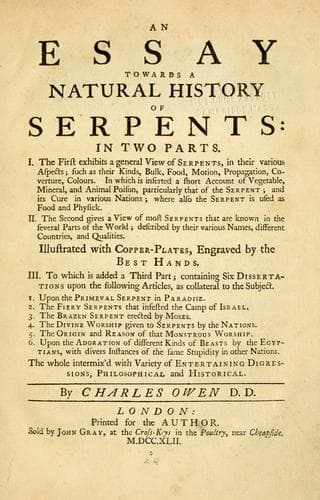
An essay towards a natural history of serpentsOwen, Charles
History
An essay towards a natural history of serpents
Owen, Charles
Serpent worship -- Early works to 1800; Serpents -- Early works to 1800; Serpents -- Religious aspects -- Early works to 1800
The bruised Leaves of the _Virginian_ Dittany are very hot, and biting
upon the Tongue: Probably the strong Smell of it might stop the Passages
of Respiration in those Animals, or ferment with the Blood, so as to
suffocate them. In _Gresham_ College at _London_ may be seen fifteen
Skins of Rattle-snakes checker’d——Some appear in ash colour: Several
Rattles of those Snakes, most of them composed of above ten Joints.
XXVIII. The _Salamander_ is an amphibious Serpent, very much spotted;
superior in Bulk to common Lizards. The _Land-Salamander_ is a little
poisonous Reptile, that resembles the green Lizard, but more gross in
Body; and is found in _Germany_ and other Places.
_CONRADUS Gesner_, says he saw one of ’em on the _Alps_ perfectly black,
with a short Tail: When wounded, a kind of milky Liquid runs out. In
_Germany_, are several great Woods, where _black Salamanders_ have been
seen; _Teste Matthiolo_[196].
Footnote 196:
_Jonstonus de Quadrupedibus_, p. 137.
This little strange Animal affects moist, cold and solitary Habitations.
In some parts of _Germany_ great numbers of them have been found in a
Body piled up, one upon another: They are of the oviparous kind, and
propagate their Species by Eggs, the common Semen of Fowls and Insects.
They are Enemies to Frogs and the Tortoise, and feed on little small
Insects; and when they have Access to Honey and Milk, they never want a
Feast.
It is of a poisonous Nature, and many have suffer’d by its Biting; so
says _Pliny_, with whom agree _Nicander_, _Aëtius_, and _Abensinæ_.
_GESNER_ is in a contrary Sentiment, and says he had domestick
_Salamanders_, that offered no violence with their Teeth without
Provocation. _Jonstonus_ adds, that in _Germany_ there appeared no ill
Effects of its Bite; but in _France_ its Wounds were of a most deadly
Nature, as appears by a Saying in that Kingdom. _viz._ _That a Man bit
by a Salamander, should have as many Physicians to cure him, as the
Salamander has Spots, which are numerous_[197].
Footnote 197:
——_tot medicis indigere quot maculas bestia habet, proverbio jactant_.
Jonstonus de Quadrupedibus, p. 137.
The _Aquatic Salamander_ is not very unlike the former, unless it be in
Colour and Figure; some with a Tail turn’d up, others with a flat Tail,
prominent in the middle: There are various sorts of them; one of which
appears in the form of a Turbot, whose Eggs are as large as
Garden-pears.
When upon Land their Mouth will not open, unless it be by Force, or they
be cast into a Vessel of Water: When put upon Salt, they move the Tail
and die; their Skin is close compacted, and not penetrable by a Sword;
and ’tis said that Swine’s Flesh is Poison to them[198].
Footnote 198:
_Jonstonus de Quadruped._ p. 138.
Public-domain text, read in full here on John Shaqi.
Reviews
Reviews
No reviews yet
Be the first to share your thoughts on this work.
Elsewhere in the archive
Join the Discussion
Join the discussion
Sign in to leave a comment or review.
Sign InorCreate an account