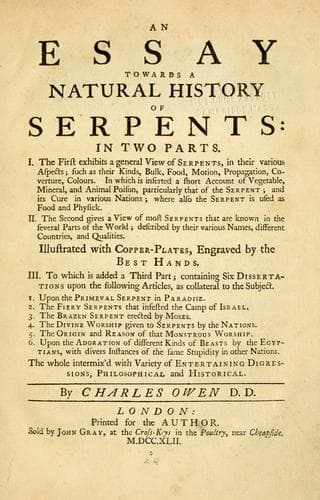
An essay towards a natural history of serpentsOwen, Charles
History
An essay towards a natural history of serpents
Owen, Charles
Serpent worship -- Early works to 1800; Serpents -- Early works to 1800; Serpents -- Religious aspects -- Early works to 1800
In _America_ is a vast variety of Serpents, and some of prodigious
Dimensions; in particular, they are very numerous and large in
_Cordillera_, i. e. _Andes_, or high Mountains of _Chile_, which
Mountains, _Antonio de Herrera_ calls a Prodigy of Nature, not to be
match’d in the kind: They are two Chains of high Mountains, about 1500
Leagues in length: In that spacious Region are Adders red as blood,
seven or eight Foot long, which in the Night appear like burning Coals,
but not so dangerous as other Serpents, that are Imps of Darkness.
_Acosta_ and other Writers tell us, that the Devil appear’d among the
_Americans_ in the shape of a Serpent.
There are so many Sorts, says _Nieuhoff_, that the _Brasilians_ reckon
up no less than thirty-two, most of which are here accounted for.
XXVII. The _Caudisonant_, or _Rattle-snake_, is a large Species of the
Viper, and in its exterior Form every way similar, the rustling Tail
excepted; it moves with as much Agility as if supply’d with Wings,
called therefore the _Flying-snake_: It has small Eyes, and four Teeth
longer than the rest, of white Colour, and sharp, like Thorns; the Head
is guarded with small Scales, the Back with larger and thicker Armour;
the Tail is composed of several loose bony Articulaments that make a
roaring Sound, loud enough to be heard at a distance; and therefore
called the _Bell-Snake_.
It is common in _Virginia_, where it appears to be from three to four
Foot long, and reckoned to be very poisonous; but scarcely hurts any,
unless provoked; and when offended, like the God of War, makes directly
at the Enemy, without dread of Consequences.
In the History of _Peru_, an Account is given of a young Woman who was
wounded by a Rattle-snake, and died on the Spot, before any Relief could
be had; and when they came to take up the Corpse, the Flesh came off her
Bones; so speedily did the violence of the Poison dissolve the structure
of the Body.
The method of killing this Snake, is thus given by Captain _Silas
Taylor_, _viz._ Of the Leaves of _Dittany_ of _Virginia_ (_i. e._ wild
Penny-royal) bruis’d, we took, says he, and having fasten’d them at the
end of a cloven Stick, we held it to the Nose of the _Rattle-snake_, who
by turning and wriggling, labour’d hard to avoid it; but was kill’d with
it in less than half an Hour’s time, and as is supposed by the meer
Scent of that Vegetable[194]. This was done _A. D._ 1657, in _July_, at
which Season those Creatures are reputed to be in the greatest Vigour
for their Poison: It is also remarkable, that in those Places where this
wild Penny-royal grows, none of these Snakes are observed to come[195].
Footnote 194:
_Regnault_, vol. ii. from _Journ. des Scav._ 1666. p. 113.
_Lowthorp_’s Abridg. of Philos. Transact. vol. ii. p. 811.
Footnote 195:
_Ibid._
Public-domain text, read in full here on John Shaqi.
Reviews
Reviews
No reviews yet
Be the first to share your thoughts on this work.
Elsewhere in the archive
Join the Discussion
Join the discussion
Sign in to leave a comment or review.
Sign InorCreate an account