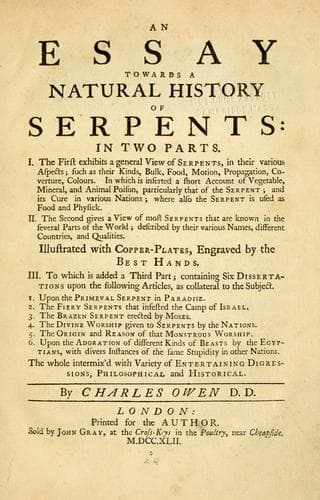
An essay towards a natural history of serpentsOwen, Charles
History
An essay towards a natural history of serpents
Owen, Charles
Serpent worship -- Early works to 1800; Serpents -- Early works to 1800; Serpents -- Religious aspects -- Early works to 1800
XXIX. The _Cameleon_ belongs to the Class of Quadrupedes, and is a
little Animal resembling a Lizard, but of a larger and longer Head: Its
Eyes stand out of its Head above one half of their Globe, which he turns
so obliquely, that he sees every thing behind him: Nature perhaps has
given it this Advantage, because its Legs (by the slowness of its
motion) are of no use to avoid his Enemy, by running away. There is yet
something more extraordinary, in the motion of his Eyes, for when one of
them moves, the other has no motion at all; one looks upward, the other
downwards[206].
Footnote 206:
A Journal of the Philosoph. Mathematical and Botanic Observ. by _Lewis
Feuillée_, A. D. 1725.
The length of these Creatures does not exceed twelve Inches, and they
have a proportionable bigness. The Skin is plaited and very fine,
transparent, jagged like a Saw, and thin; and must be very compact and
hard, since, according to the Historian[207], ’tis not penetrable by the
Teeth of Serpents. It has four Feet, and on each Foot three Claws; its
Tail is long and flat, with which, as well as with its Feet, it fastens
itself to the Branches of Trees: its Nose long, and ends in an obtuse
point: In other respects it is made like a Fish; that is to say, it has
no Neck[208]: Reckoned by _Moses_, _among the unclean_—Numb. xi. 30.
Footnote 207:
_Ælian,_ iv. 33.
Footnote 208:
_Calmet,_ p. 351.
The _Cameleon_ is said to transform itself into variety of Colours;
perhaps this change may arise from the different reflections of the Rays
of Light: Thus they may put on a brown or whitish Habit, from Trees of
that Colour, on which they sit. Others observe, that its Colour is
changeable, according to the various Passions that agitate the Creature;
_e. g._ When affected with Joy, ’tis of an emerald Green, mixt with
Orange, etch’d with little grey and black Strokes: Anger gives it a
livid and dusky Colour: Fear makes it pale, and like faded yellow[209].
All these Colours compose such a pretty Medley of Shadow and Light, that
Nature does not afford a finer Variety of Shadowing, nor our finest
Pictures more lively, sweet, and proportionable Drawing.
Footnote 209:
_Le Compte’s Memoirs_, p. 502.
For the further Illustration of this Subject, I shall add something from
the Philosophical Transactions about a female Cameleon, the Skin of
which appear’d mixt of several Colours, like a Medley-cloth. The Colours
discernable are green, a sandy yellow: And indeed one may discern, or at
least fancy, some mixture of all, or most Colours in the Skin, whereof
some are more predominant, at different times: There are some permanent
black Spots on the Head, and Ridge of the Back. But our modern
Naturalists assure us, that its common Colour, when it is at rest, and
in the Shade, is a bluish grey; when ’tis exposed to the Sun, this grey
changes into a darker grey, inclining to a dun Colour: If ’tis put on a
black Hat, it appears to be of a violet Colour.
Public-domain text, read in full here on John Shaqi.
Reviews
Reviews
No reviews yet
Be the first to share your thoughts on this work.
Elsewhere in the archive
Join the Discussion
Join the discussion
Sign in to leave a comment or review.
Sign InorCreate an account