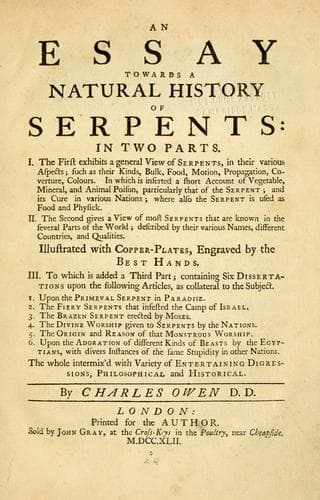
An essay towards a natural history of serpentsOwen, Charles
History
An essay towards a natural history of serpents
Owen, Charles
Serpent worship -- Early works to 1800; Serpents -- Early works to 1800; Serpents -- Religious aspects -- Early works to 1800
... Upon Excitation or warming, she becomes suddenly full of little
black Spots, equally dispersed on the sides, with small black Streaks on
the Eyelids; all which afterward do vanish. The Skin is grain’d with
globular Inequalities, like the Leather call’d Shagreen. The grossest
Grain is about the Back and Head, then on the Legs; on the Sides and
Belly, finest; which, perhaps, in several Postures, may shew several
Colours; and when this Animal is in full Vigour, may also have in some
sort, _Rationem Speculi_, and reflect the Colours of Bodies adjacent;
which, together with the mixture of Colours in the Skin, may have given
occasion to the old Tradition, _of changing into all Colours_[210].
Footnote 210:
_Lowthorp_’s _Abridg._ vol. ii, p. 816.
A certain curious Gentleman, made the following Experiment, when he
lived at _Smyrna_, in _Asia-minor_: He bought some _Cameleons_, to try
how long they could be preserved alive under Confinement; he kept them
in a large Cage, and allowed them the Liberty to take the fresh Air,
which they suck’d in with Pleasure, and made them brisker than ordinary.
He never saw them either eat or drink, but seem’d to live on the Fluid
in which we breathe.
The Antients were persuaded that _Cameleons_ fed upon the Air, for which
reason one of the Fathers calls it a _living Skin_[211]; but now it
appears by Experience, that they feed upon different Insects, as
Palmer-worms, Locusts, Beetles, Flies, and also Leaves of Vegetables.
Father _Feuillée_[212], in a Journey into _Asia-minor_, opened one of
these Animals, and found in its Belly Peach-Leaves, which were not then
digested.——_N. B._ Digestion is very slow in _Cameleons_, which is the
reason why they take so little Nourishment.
Footnote 211:
_Pellicula vivit. Tertull. de Pallio_, cap. 3.
Footnote 212:
_Feuillée_’s _Journal. Franckf._ 1597. p. 3.
The same Father mentions a small Lizard, which he saw in _Peru_, that
was not above an Inch thick, which he calls _Chameleontides_, because he
changed his Colour, like the _Cameleons_; being in a certain Situation,
he saw it of a dun Colour; in another, ’twas green.... This little
Creature, he says, had the same Figure and Proportion as the _Great
Lizard_; nam’d by the _Spaniards_, _Iquanna_; and _Senembi_, by
_Marcgravius_; and he makes that _Lizard_ a fourth kind of _Cameleon_,
and to be added to the two kinds of _Bellonius_, one of which is to be
found in _Arabia_, and the other in _Egypt_, and to that mention’d by
_Faber_, _Lynceus_, which may be seen in _Mexico_.
Their Tongue is somewhat peculiar, it being as long as their Body, with
which they catch Flies, and other Insects, which settle on their
Tongues, to suck the viscous slimy Matter, adherent to them. The
_Cameleon_ puts out his Tongue to draw them upon it, and when ’tis full
of these Insects, he pulls it in with wonderful Agility. Others think,
it encloses its Prey with the tip of its Tongue, which is made in a form
proper for that purpose.
Public-domain text, read in full here on John Shaqi.
Reviews
Reviews
No reviews yet
Be the first to share your thoughts on this work.
Elsewhere in the archive
Join the Discussion
Join the discussion
Sign in to leave a comment or review.
Sign InorCreate an account