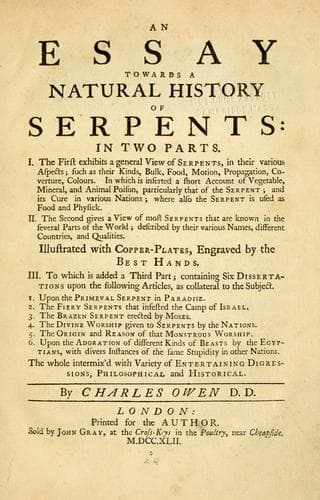
An essay towards a natural history of serpentsOwen, Charles
History
An essay towards a natural history of serpents
Owen, Charles
Serpent worship -- Early works to 1800; Serpents -- Early works to 1800; Serpents -- Religious aspects -- Early works to 1800
Their Priests were bloody Men, a Brood of Vipers, and had such an
Ascendant over their Princes, that they made them believe _their Gods
were angry_, and not to be appeased without 4000 or 5000 Men to
sacrifice in a day; so that, right or wrong, they must make War on their
Neighbours, to procure those Victims to keep their Priests in Humour.
The next, is an Instance of _Spanish Cruelty_, in this Country, that
could have no Original but Hell, the Seat of the old Serpent. It runs
thus, _viz._ _Barthol. de las Casas_ Bishop of _Chiapa_, in a Letter to
the _Emperor Charles V._ gives this account of the Barbarity of the
_Spaniards_ towards the poor Inhabitants, Natives of the Land.
... “Their Kings and Princes, says the Bishop, the _Spaniards_
scorch’d to death, or tore in pieces with Dogs: The poor People
they burnt in their Houses, and dash’d out the Brains of their
Children: Those that were spared, they forced to carry greater
Burdens than they were able to bear, by which thousands of them
were destroy’d: Others who escap’d, died of Famine in the Woods,
after they had kill’d their own Wives and Children, and eat them
for hunger. In this one Province they murder’d above two
Millions of Men, not sparing those of Quality, who had civilly
entertain’d them. They tortured the Natives with the most
hellish Inventions, to make them discover their Gold. _Diego de
Valesco_, in particular, spared none that fell into his hands,
so that in a Month’s time he murder’d ten thousand: He hang’d
thirteen Noblemen.
“Some they starved to death, by thrusting their Heads betwixt
Pieces of cloven Timber: Others they buried alive, leaving their
Heads above Ground, at which they bowl’d with large
Iron-Bullets: They also forced them to eat one another.——
Besides other hellish Cruelties too dreadful to be related[221].” _N.
B._ This _Barth. de las Casas_ had been a _Friar_, and afterwards made
Bishop of _Chiapa_, was a Man of more Piety and Justice than is commonly
found among _Friars_. It was he, who procur’d the _Indians_ their
Liberty from being Slaves to the _Spaniards_, which they enjoy to this
day, so that they are paid for what they do, about half a Crown a Week.
Footnote 221:
_Acosta_, _Gage_—The Civil and Moral History of the _Spanish
West-Indies_, in _Atlas Geogr. America_.
XXXIII. The _Ibitobaca_ is a Serpent of _Chiapa_, near four Foot long,
and of a crimson Colour, adorn’d with a pleasing Diversity of black and
white Specks; wearing its Bones as a Necklace, or the Ruff in Queen
_Elizabeth_’s Reign, who destroy’d the Invincible Armada, and made good
old _England_ a Terror to _Spaniards_.
XXXIV. The _Iquanna_ is the Birth of _Mexico_, a Serpent like the Pope’s
Anathema, of a terrible Front, but harmless; a glittering Comb on the
Head, with a Bag under the Chin; a long Tail, and sharp Bones on its
Back, standing up in the form of a Saw.
Public-domain text, read in full here on John Shaqi.
Reviews
Reviews
No reviews yet
Be the first to share your thoughts on this work.
Elsewhere in the archive
Join the Discussion
Join the discussion
Sign in to leave a comment or review.
Sign InorCreate an account