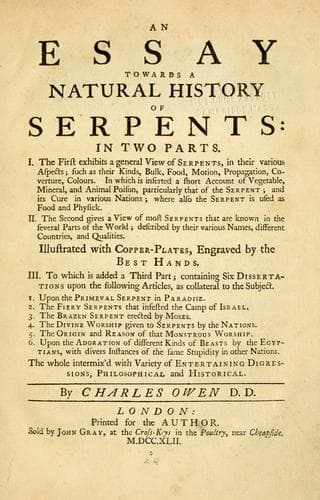
An essay towards a natural history of serpentsOwen, Charles
History
An essay towards a natural history of serpents
Owen, Charles
Serpent worship -- Early works to 1800; Serpents -- Early works to 1800; Serpents -- Religious aspects -- Early works to 1800
XXXI. The _Ibiara_ is a _Brasilian_ Adder, about a Foot and half long;
an Inch and half in thickness. Serpents of this kind are very numerous
in that Country, and nothing more poisonous than their Wounds, tho’ not
incurable, if proper Remedies be applied in time.
In Seasons of Danger, they shelter themselves in Cavities under Ground,
and feed upon Pismires, which are very large in that Country, and in
such prodigious Quantities, that the _Portuguese_ call them, _Kings of
Brasil_.
XXXII. In _Chiapa_, in _Old-Mexico_, now call’d _New-Spain_, is a
noxious Animal call’d _Teuthlacokauqui_, or _Fortress of the Serpents_,
whose Head is like an Adder, thick Belly, glittering Scales, the Ridge
of the Body black, with an Interspersion of white Crosses; the Teeth
poisonous, and the biting kills in twenty-four hours, unless the wounded
part be held in the Earth so long, till the Pain be over.
It has a frightful Aspect; when it moves it makes a Noise with its Tail,
that sounds an Alarm of Danger. The _Americans_, who have the Art of
taking it by the Tail, carry it home, and by degrees make it tame: ’tis
maintain’d at a cheap rate, for it can subsist a whole Year without any
visible Food.
_JOHNSTONUS_ calls this Serpent the _Bocininga_, and describes it from
_Marcgravius_ and _Piso_. The former says, ’tis four Foot and three
Fingers long, Belly smooth, small Eyes, forked Tongue, rattling Tail.
The other observes, the _Spaniards_ call it _Cascavel_, and _Tangedor_,
because its Tail emits the sound of a Ball; in thickness, as a Man’s
Arm; in length, about five Foot; a cloven Tongue, long and sharp Teeth;
of a dark Colour, inclining to the yellow[219].
Footnote 219:
_Jonstonus_, Articulus xvii. p. 23.
According to _Nierembergius_, this Serpent is called the _Queen of
Serpents_, which they suppose to be like the Viper, in its Poison, and
Shape of the Head[220]. By the Definitions of several Authors, this
Serpent seems to be the _Caudisonant_; and the _Dutch_ in _America_ call
it, the _Ratel-Stange_, _i. e._ Rattle-Snake.
Footnote 220:
_Historia Naturæ Maximè Peregrinæ_, p. 268-9.
Now we are in _Mexico_, excuse me in giving you two Instances of
monstrous Cruelty; one in the Natives, the other in the _Spaniards_.
When the _Mexicans_ were disposed to do signal Honour to their Idols,
they sent out Armies to bring in Prisoners for a Sacrifice, whose Flesh
they did afterwards eat; and _Montezuma_ the Emperor, commonly
sacrificed 20000 Men, one year with another, and no less than 50000 some
years. The Priests thought it dishonourable to sacrifice less than 40 or
50 Captives at a time to one _Idol_. At a certain Festival, they ript up
the Breast of a manumitted Slave, pull’d out his Heart, which they
offer’d to the Sun, and then eat up his Body.
Public-domain text, read in full here on John Shaqi.
Reviews
Reviews
No reviews yet
Be the first to share your thoughts on this work.
Elsewhere in the archive
Join the Discussion
Join the discussion
Sign in to leave a comment or review.
Sign InorCreate an account