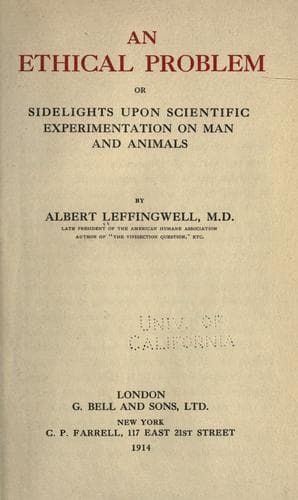
An ethical problem; or, Sidelights upon scientific experimentation on man and animalsLeffingwell, Albert
Philosophy
An ethical problem; or, Sidelights upon scientific experimentation on man and animals
Leffingwell, Albert
Medicine, Experimental; Vivisection
The action of the poison thus made is exceedingly rapid. Numerous
experiments by different observers have demonstrated that it swiftly
destroys the functions of the motor nerves of the body, leaving the
sensory nerves unaffected to any extent. Claude Be'rnard, who made
many experiments with curare, came to the same conclusion; it
abolishes the power of motion, but has no effect upon the nerves of
sensation. An American physiologist, Dr. Isaac Ott, tells us that it
is able to render animals immovable "by a paralysis of motor nerves
,LEAVING SENSORY NERVES INTACT." Be'rnard asserts as a result of
numerous experiments that in an animal poisoned with curare, "its
intelligence, sensibility and will-power are not affected, but they
lose the power of moving;" and that death, apparently so calm, "is
accompanied by sufferings the most atrocious that the human
imagination can conceive." Although it may seem to be a corpse without
movement, and with every appearance of death, "sensibility and
intelligence exist ... it hears and comprehends whatever goes on, and
feels whatever painful impressions we may inflict." It is only within
late years, and since the employment of curare has been denounced,
that anyone has suggested any doubt of these physiological
conclusions.
It has been found by physiologists that if the throat of a dog be
severed and the windpipe exposed and artificial respiration kept up,
all the functions of life may be greatly prolonged; and if curare be
used, the creature does not die, although it feels. Supposing that
morphia or chloroform be administered at the same time--is the animal,
notwithstanding, conscious of pain? Professor Starling admitted in his
evidence that if the anaesthetic passed off, the curarized animal
would be unable to move or to show any sign of suffering; there would
be no possibility of a dog whining or moaning; "it could not, under
curare," he frankly admits. Dr. Thane, one of the Government
inspectors of laboratories, gave interesting evidence on this point,
in reply to questions of one of the Commissioners.
"What is the object of giving curare when you are going to give an
anaesthetic?"
"The object of giving curare is to stop all reflex movements...."
"It would stop all struggling, would it not?"
"IT WOULD STOP ALL STRUGGLING."
"That is to say, it would put an end to the usual signs of the animal
not being properly under anaesthesia?"
"That is so."
"And in that case the experimenter has to depend solely, not upon the
attendant, but upon the accuracy of his apparatus? He cannot tell from
looking at the animal, which is perfectly still, whether it is
suffering or not?"
"If his apparatus breaks down, the animal will die of suffocation; it
will not get air."
"Yes, it may die; but so long as it is alive, HE could not say, YOU
could not say, I could not say--if I were present--that the animal was
properly under anaesthesia, IF THERE WERE NO SIGNS BY WHICH YOU CAN
TELL?"
Public-domain text, read in full here on John Shaqi.
Reviews
Reviews
No reviews yet
Be the first to share your thoughts on this work.
Elsewhere in the archive
Join the Discussion
Join the discussion
Sign in to leave a comment or review.
Sign InorCreate an account