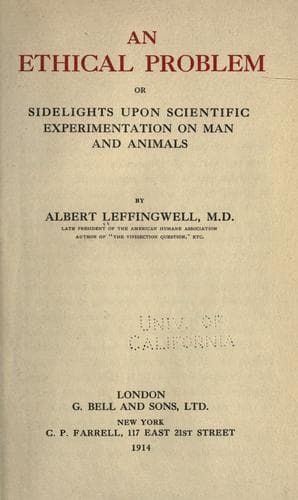
An ethical problem; or, Sidelights upon scientific experimentation on man and animalsLeffingwell, Albert
Philosophy
An ethical problem; or, Sidelights upon scientific experimentation on man and animals
Leffingwell, Albert
Medicine, Experimental; Vivisection
"We could say the animal is respiring air which is charged with
anaesthetic in sufficient quantity to keep it anaesthetized before we
gave it curare."
"That is all you could say?"
"That is all we could say."[1]
[1] Evidence taken November 21, 1906.
And this pious opinion Dr. Thane reiterates to other questioners. It
fails to satisfy except where faith is strong. "The curious thing to
me," said Dr. George Wilson, "is that you or anyone else can say
positively that an animal which cannot, by moving, give any indication
that it is not completely anaesthetized during all this time that it
is under a terribly severe operation does not suffer.... I cannot
understand such a positive statement." And after Dr. Starling had
admitted the impossibility of a dog, under curare, making any cry,
Dr. Wilson rejoins: "THEN HOW CAN YOU TELL THAT IT SUFFERS NO PAIN?
You may hope and believe, but how can you tell that during a prolonged
and terrible experiment, the animal suffers no pain?" The only reply
that the experimenter could give was a reiteration of faith in the
working of the apparatus.
And here, for the present, the problem must be left. Its only answer
is a guess. Yet it should be capable of a definite solution. Every
year, in our great cities, it becomes necessary to put homeless dogs
out of existence in some merciful way. It should be possible, by use
of chloroform, to determine which theory is true. If, under proper
circumstances, a dozen animals were made absolutely unconscious by the
use of chloroform, as insensible as human being are made before a
capital operation, so that the corneal reflex is abolished, could this
degree of unconsciousness be maintained "as long as any experimenter
desired"? Would it even be possible as a rule to keep them alive a
week, yet completely anaesthetized? Or, on the contrary, would such
animals be peculiarly liable to sudden death from the effects of the
chloroform? One cannot doubt the possibility of laboratory anaesthesia
being maintained indefinitely; but how is it with complex and full
surgical anaesthesia? Until such appeal to science shall have been
made in the presence of those who doubt, and are able to judge, the
question cannot be regarded as settled. There are those who will
believe that the older investigators were right; that the perfect
insensibility to pain is not invariably attained in these cases; and
that both in English and American laboratories the most hideous
torments are sometimes inflicted upon man's most faithful servant and
friend. Even Dr. Thane, the Government inspector, admitted that in
making reports the inspector "never could determine which experiments
were painless and which were painful."
Public-domain text, read in full here on John Shaqi.
Reviews
Reviews
No reviews yet
Be the first to share your thoughts on this work.
Elsewhere in the archive
Join the Discussion
Join the discussion
Sign in to leave a comment or review.
Sign InorCreate an account