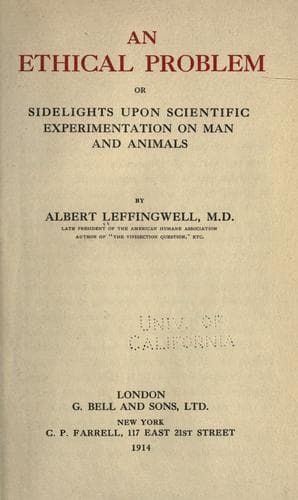
An ethical problem; or, Sidelights upon scientific experimentation on man and animalsLeffingwell, Albert
Philosophy
An ethical problem; or, Sidelights upon scientific experimentation on man and animals
Leffingwell, Albert
Medicine, Experimental; Vivisection
The final report of the Royal Commission occupies a volume. The long
period over which the inquiry extended, the generally apparent desire
to permit every phase of opinion to have a hearing, all tended toward
views which, if not unanimous, at any rate indicated a desire to be
fair. Taken as a whole, the evidence and the final decisions of the
Commission constitute an important contribution to the literature of
animal experimentation which has appeared during the present century.
The conclusions of the Commission are almost, yet not quite,
unanimous. All of the eight members signed the final report, three of
them, however, making their assent subject to a qualifying memorandum
that in certain respects indicated a considerable divergence of
opinion. The following are the conclusions of the Commission, the
words in italics and parentheses being the qualifying additions of one
of their number, Dr. George Wilson.
"Altogether, apart from the moral and ethical questions involved in
the employment of experiments on living animals for scientific
purposes, we are, after full consideration, inclined to think--
"1. That certain results, claimed from time to time have been proved
by experiments upon living animals, and alleged to have been
beneficial in preventing and curing disease, have, upon further
investigation, been found to be fallacious or useless. (INDEED, THE
FALLACIES AND FAILURES ARE, IN MY OPINION, FAR MORE CONSPICUOUS THAN
SUCCESSFUL RESULTS.)
"2. That notwithstanding such failures, valuable knowledge has been
acquired in regard to physiological processes and the causation of
disease, and that (SOME) methods for the prevention, cure, and
treatment of certain diseases (OTHER THAN BACTERIAL), have resulted
from experimental investigations upon living animals.
"3. That, as far as we can judge, it is highly improbable that,
without experiments made upon animals, mankind would by now have been
in possession of such knowledge.
"4. That in so far as disease has been successfully prevented, or its
mortality reduced, suffering has been diminished in man and the lower
animals.
"5. That there is ground for believing that similar methods of
investigation, if pursued in the future, will be attended with similar
results." (FAILURES PLENTIFUL ENOUGH STILL, BUT SUCCESSFUL RESULTS
FEWER AND FEWER AS THE FIELD OF LEGITIMATE RESEARCH MUST BECOME
GRADUALLY MORE AND MORE RESTRICTED.)
Other conclusions appear to be as follows:
"We strongly hold that limits should be placed to animal suffering in
the search for physiological or pathological knowledge."
How far interference with experimentation should extend appears to
have been a matter of divergent views. Five of the Commissioners took
the following position:
Public-domain text, read in full here on John Shaqi.
Reviews
Reviews
No reviews yet
Be the first to share your thoughts on this work.
Elsewhere in the archive
Join the Discussion
Join the discussion
Sign in to leave a comment or review.
Sign InorCreate an account