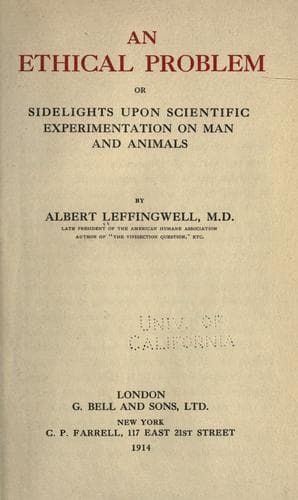
An ethical problem; or, Sidelights upon scientific experimentation on man and animalsLeffingwell, Albert
Philosophy
An ethical problem; or, Sidelights upon scientific experimentation on man and animals
Leffingwell, Albert
Medicine, Experimental; Vivisection
The evidence given by experimenters was frequently very curious, and
sometimes suggestive. Professor Starling, for example, testified that
dogs exhibited no fright or fear at entering a vivisection chamber;
there are no signs "that they have ANY IDEA OF WHAT THEY ARE GOING TO
SUFFER," said the physiologist; "that is a great consolation in
dealing with animals, as compared with dealing with a man."[1]
"GOING TO SUFFER" is a somewhat significant admission. He is asked
whether the experimentation of to-day is more or less humanely
conducted than it was before the Act of 1876; and instead of replying
he tells the Commissioners that "there was very little work carried
out before the Act; THERE WERE ONLY ONE OR TWO PHYSIOLOGISTS." Upon
such ignorance of history comment is hardly necessary. We have heard
much concerning a "wonderful discovery" of a Dr. Crile, the giving of
morphia before a surgical operation, in order to quiet the
apprehensions of the patients and so to prevent the occurrence of
shock. Yet as long ago as 1906, Dr. Thane, a member of the Royal
College of Surgeons, testified, upon the authority of a distinguished
scientist, that such use of morphia before administration of
anaesthetics "is often done in surgical operations." The attention of
Sir Victor Horsley was called to the experiments of a Dr. Watson in
America. Had he heard of them?
[1] Minutes of Evidence, Q. 3,885.
"Yes, I know of those experiments," was the reply.
"Were they, in your opinion, valuable experiments?"
"I cannot, at the moment, call to mind whether they revealed any new
conditions. I should have to look them up again."
"Were they justifiable, in your opinion?"
"CERTAINLY," was Sir Victor Horsley's terse reply.
Yet, when the account of these experiments was first published, the
British Medical Journal, in its editorial columns, thus commented upon
them:
"The present pamphlet calls for our strongest reprobation as a record
of the most wanton and stupidest cruelty we have ever seen chronicled
under the guise of scientific experiments.... Apart from the utterly
useless nature of the observations, so far as regards human pathology,
there is a callous indifference shown in the description of the
suffering of the poor brutes which is positively revolting.... WE
TRUST THAT NO ONE, IN THE PROFESSION OR OUT OF IT, will be tempted by
the fancy that these or such-like experiments are scientific or
justifiable."
It will be seen that concerning Watson's most cruel vivisections Sir
Victor Horsley was not in agreement with the British Medical Journal,
the official organ of the Association of which, before the Commission,
he appeared as the representative!
Public-domain text, read in full here on John Shaqi.
Reviews
Reviews
No reviews yet
Be the first to share your thoughts on this work.
Elsewhere in the archive
Join the Discussion
Join the discussion
Sign in to leave a comment or review.
Sign InorCreate an account