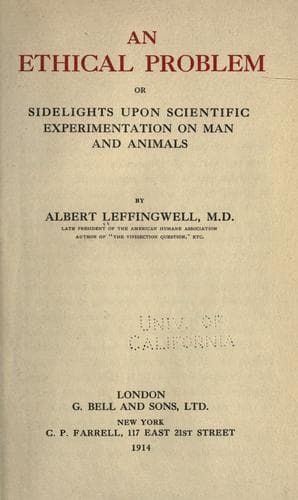
An ethical problem; or, Sidelights upon scientific experimentation on man and animalsLeffingwell, Albert
Philosophy
An ethical problem; or, Sidelights upon scientific experimentation on man and animals
Leffingwell, Albert
Medicine, Experimental; Vivisection
What are we to say of the results, either to science or the art of
healing, which modern vivisection has contributed? It is regarding
this point that Dr. Wilson has brought together a mass of evidence of
unquestionable value, in a field of inquiry peculiarly his own. For
more than thirty years he had been a writer upon topics pertaining to
the Public Health. One by one, in his memorandum, Dr. Wilson has
examined the claims of vivisection regarding the chief forms of
disease which have occupied the attention of experimenters--cancer,
which still maintains its advance in fatality; tuberculosis, which
began to decline in England more than forty years ago, before it was
associated with experimentation; hydrophobia, diphtheria, tetanus,
typhoid fever, snake-poison, sleeping-sickness, and certain animal
ailments of an infectious character. What is his conclusion regarding
all the claims of vastly increased potency of modern medicine over
these powers of darkness and death? That experiments have been utterly
valueless? No; some useful knowledge has been acquired, in certain
directions. "But I still contend, and have endeavored to prove, that
the useful results which have been claimed, or may still be claimed,
HAVE BEEN ENORMOUSLY OVER-ESTIMATED." And the final conclusion of this
keen observer and lifelong student of medicine is this: "That
experiments on animals, no matter with what prospective gain to
humanity, are repellant to the ethical sense; and that those who
persistently advocate them as beneficial to human or animal life MUST
JUSTIFY THEIR CLAIMS BY RESULTS.... Even admitting that experiments on
animals have contributed to the relief of human suffering, such
measure of relief is infinitesimal compared with the pain which has
been inflicted to secure it."
What changes to the existing law of England regarding animal
experimentation, or in the administration of the Act, did this
Commission recommend?
FIRST. AN INCREASE IN THE NUMBER OF INSPECTORS. "The inspectors
should be sufficiently numerous and should have at their command ample
time to afford to the public reasonable assurance that the law is
faithfully administered."
SECOND. RESTRICTIONS IN THE USE OF CURARE. "We are all agreed, that
if its use is to be permitted at all, an inspector, or some person
nominated by the Secretary of State, should be present from the
commencement of the experiment, who should satisfy himself that the
animal is throughout the whole experiment and UNTIL ITS DEATH IN A
STATE OF COMPLETE ANAESTHESIA."
This is a most remarkable recommendation. Can it imply anything else
than distrust of the experimenter?
THIRD. "STRICTER PROVISIONS REGARDING THE PRACTICE OF PITHING." The
operation must be complete; performed only under an adequate
anaesthetic; and by a licensed person when made on a warm-blooded
animal.
FOURTH. "ADDITIONAL RESTRICTIONS REGULATING THE PAINLESS DESTRUCTION
OF ANIMALS which show signs of suffering after the experiment."
Public-domain text, read in full here on John Shaqi.
Reviews
Reviews
No reviews yet
Be the first to share your thoughts on this work.
Elsewhere in the archive
Join the Discussion
Join the discussion
Sign in to leave a comment or review.
Sign InorCreate an account