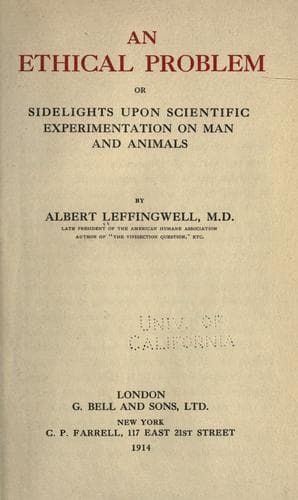
An ethical problem; or, Sidelights upon scientific experimentation on man and animalsLeffingwell, Albert
Philosophy
An ethical problem; or, Sidelights upon scientific experimentation on man and animals
Leffingwell, Albert
Medicine, Experimental; Vivisection
To this recommendation and its suggested amendment by three of the
Commissioners, reference has already been made.
FIFTH. "A CHANGE IN THE METHOD OF SELECTING and in the constitution of
the Advisory body to the Secretary of State."
SIXTH. "SPECIAL RECORDS BY EXPERIMENTERS IN CERTAIN CASES." On this
point we have seen that three of the Commissioners went yet farther,
and believed that in ALL cases of painful experiment--and, possibly,
in all cases whatsoever, such reports should be made.
It is now upwards of thirty-five years since the Act regulating the
practice of vivisection in England came into effect. During all that
period, in the United States, the law has never ceased to be an object
of misrepresentation and attack. Before Legislatures and Senate
Committees, on the platform and in the press, by men of good
reputation but associated with laboratory interests, the English law
has been denounced as a hindrance to scientific progress and a warning
against similar legislation in the United States. And yet nothing can
be more evident that all these attacks were based upon ignorance and
misstatement. We find a Royal Commission in England, composed almost
entirely of scientific men, everyone of them favourable to animal
experimentation, devoting years to an inquiry concerning not
vivisection only, but the working of the law by which it is
regulated. And the conclusions reached are in every respect opposed
to the statements made by the laboratory interests here. THEY FULLY
ENDORSE THE PRINCIPLE OF STATE REGULATION, WHICH EVERYWHERE IN AMERICA
IS SO STRENUOUSLY OPPOSED. But this is not all. Every recommendation
made for modification of the Act is in the direction of animal
protection, and toward an increased stringency of the regulations
relating to animal experimentation. In not a single instance was
there recommendation that the regulations should be less stringent;
not an instance in which it was suggested that privileges of the
vivisector should be enlarged. That this should be the result of an
inquiry in this twentieth century, extending over five years, is
remarkable indeed. Perhaps there is no reason for surprise that all
these conclusions of the Royal Commission were never made known to the
American public by the periodicals of the day. Is it possible for
anyone to believe that such conclusions would ever have been attained
if the denunciations of State regulation of vivisection, proceeding
from the American laboratory, had been grounded in truth?
CHAPTER XI
THE GREAT ANAESTHETIC DELUSION
Public-domain text, read in full here on John Shaqi.
Reviews
Reviews
No reviews yet
Be the first to share your thoughts on this work.
Elsewhere in the archive
Join the Discussion
Join the discussion
Sign in to leave a comment or review.
Sign InorCreate an account