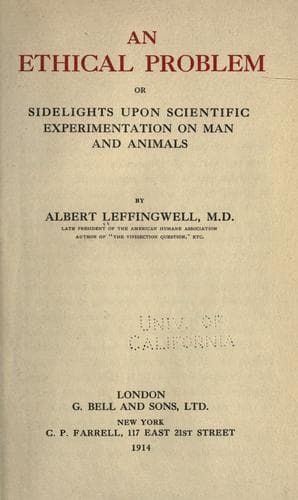
An ethical problem; or, Sidelights upon scientific experimentation on man and animalsLeffingwell, Albert
Philosophy
An ethical problem; or, Sidelights upon scientific experimentation on man and animals
Leffingwell, Albert
Medicine, Experimental; Vivisection
A popular delusion is often the basis of a great abuse. If at one
time witches were burnt by countless thousands, it was at a period
when implicit faith in the reality of diabolic conspiracy was
undisturbed by sceptical questionings. Human slavery existed for
centuries, not only because it was profitable, but because it came to
be regarded as the only conceivable permanent relation between the
negro and the white man. The Spanish Inquisition existed for ages,
because the pious Spaniard could not believe that the good men who
upheld, encouraged, and promoted its activity could be liable to
error, or actuated by other than the loftiest principles. Men find
themselves deluded not merely because of their faith in the integrity
of their fellow-men, but because they have also extended that faith to
the accuracy of their opinions.
There can be no doubt of the fact that public apathy regarding the
abuses of vivisection as now carried on without limitations or
restrictions is grounded upon the great anaesthetic delusion. This
misinterpretation of facts, this misunderstanding of scientific
statements, constitutes the most singular delusion of the present
time.
What is anaesthesia? It has been defined as a state of insensibility
to external impressions, sometimes introduced by disease, but more
generally in modern surgery by the inhalation of the vapours of ether
or chloroform. The discovery of the properties of these drugs
constitutes a very interesting chapter in the story of scientific
achievement; but in this connection the chief point of interest lies
in the fact that the most wonderful of all advances in medicine was
made without resort to the vivisection of animals. Sir Benjamin Ward
Richardson, an English scientist who had much to do with its various
methods, tells us that "the instauration of general anaesthesia came
from experiments on man alone; there is no suspicion of any experiment
on a lower animal in connection with it"; and Professor Bigelow, of
Harvard Medical School, as we have seen, makes the same statement.
The extent to which insensibility may be carried depends entirely on
the amount of the vapour inhaled. Suppose the quantity to be very
small. Then the result will be a diminished sensibility, without
entire loss of consciousness. Let the quantity inhaled be
considerably increase, and we may produce a profound stupor with
muscular relaxation, the eyes are fixed, and the eyelids do not
respond when the eyeball is touched. There is now deep anaesthesia,
and complete unconsciousness to the surgeon's knife. The borderline
between life and death is not distant; and if still more of the
anaesthetic is administered, we may reach a condition from which there
is no awakening. The skill of the anaesthetist is not unlike that of
a pilot, who needs to know just how far the ship may be steered in a
difficult channel without running upon the rocks.
Public-domain text, read in full here on John Shaqi.
Reviews
Reviews
No reviews yet
Be the first to share your thoughts on this work.
Elsewhere in the archive
Join the Discussion
Join the discussion
Sign in to leave a comment or review.
Sign InorCreate an account