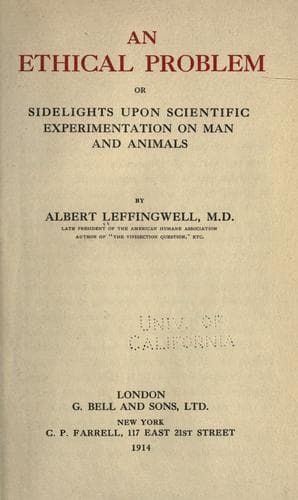
An ethical problem; or, Sidelights upon scientific experimentation on man and animalsLeffingwell, Albert
Philosophy
An ethical problem; or, Sidelights upon scientific experimentation on man and animals
Leffingwell, Albert
Medicine, Experimental; Vivisection
Now, the omission of this statement is peculiarly significant. If it
had been possible, we may be quite sure that such a statement would
have been made. Suppose, for example, that in place of vague
generalities the experimenter had said:
"Before the commencement of each experiment, the animal was deeply
anaesthetized by the inhalation of chloroform or ether, or both; and
the insensibility thus induced before the experiment began was
maintained until the death of the animal. Curare was never used. In
no instance and at no time during any experiment was the anaesthesia
otherwise than profound; the corneal reflex was never to be obtained,
nor was any other sign of sensibility to pain ever to be noted."
A statement like this would have been definite. But with due regard
for truth, it could not have been made. Instead of an explicit
statement, we have merely the assertion--so easily misunderstood--
that "in all cases the animals were anaesthetized." And this statement
may mean nothing whatever, so far as concerns the painlessness of
these vivisections.
SECOND. GREAT CARE WAS APPARENTLY TAKEN IN SOME CASES TO PREVENT DEEP
ANAESTHESIA.
It is a well-known fact that dogs are peculiarly susceptible to
chloroform, and very likely to die while under its influence. The
president of the Royal Academy of Medicine in Ireland, a teacher of
science for many years, Sir Thornley Stoker, stated in his testimony
that a dog's heart is very weak and irregular. "I fear that in the
case of dogs, anaesthesia is not always pushed to a sufficient extent,
as these animals often die from the effects of the anaesthetic if
given to a full extent.... THE ANAESTHESIA CANNOT BE COMPLETE, if the
dog lives as long as is necessary for some of these experiments."[1]
[1] Testimony before Royal Commission, Questions 761, 836.
Now, one of these experiments lasted over three hours, and many of
them over an hour. How many of the 148 animals died because the
anaesthesia was TOO DEEP?
On this point the admissions of the experimenter seem especially
significant. "OVER-ANAESTHESIA rendered the animals subject to early
collapse, and decidedly less capable of enduring a protracted
experiment." During certain experiments, "CONSIDERABLE CARE was
necessary to prevent excessive inhalation of the anaesthetic by the
animal." And yet all that could happen to the unfortunate victim would
be a painless death; to prevent that would require, doubtless,
considerable care. "If the animals were allowed PARTIALLY TO RECOVER
FROM THE EFFECT OF THE ANAESTHETIC, care was necessary in reducing
them again to surgical anaesthesia, as an excess of the anaesthetic
was liable to be inhaled."[1] This admission is evidence complete,
that the insensibility was not always maintained from beginning to
end; the creatures were in some cases--how many we can never know--
"ALLOWED PARTIALLY TO RECOVER."
Public-domain text, read in full here on John Shaqi.
Reviews
Reviews
No reviews yet
Be the first to share your thoughts on this work.
Elsewhere in the archive
Join the Discussion
Join the discussion
Sign in to leave a comment or review.
Sign InorCreate an account