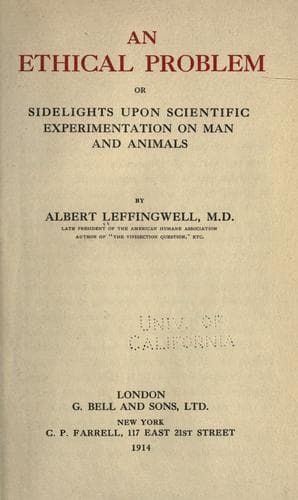
An ethical problem; or, Sidelights upon scientific experimentation on man and animalsLeffingwell, Albert
Philosophy
An ethical problem; or, Sidelights upon scientific experimentation on man and animals
Leffingwell, Albert
Medicine, Experimental; Vivisection
In the detailed accounts of these vivisections, we find more than one
proof of the sensibility of the animals. Take the following:
EXPERIMENT 126. "The animal did not take the anaesthetic well, and
part of the experiment was made under INCOMPLETE ANAESTHESIA." There
was noted, also, "contraction of the abdominal muscles, on account of
INCOMPLETE ANAESTHESIA."
EXPERIMENT 133. "Bunsen's flame to the right paw.... In the control
experiments, as well as this, THE DOG WAS NOT UNDER FULL ANAESTHESIA
... THE ANIMAL STRUGGLED ON APPLICATION OF THE FLAME."
EXPERIMENT 5. "UNDER INCOMPLETE ANAESTHESIA, crushing of foot caused a
very sharp rise, followed by an equally sharp decline of pressure.
THIS WAS REPEATED SEVERAL TIMES. Under full anaesthesia crushing of
paws caused rise again."
EXPERIMENT 4. "First, crushing of paw.... Second, crushed foot
extensively, JUST BEFORE CORNEAL REFLEX WAS ABOLISHED."
To the average reader the last few words convey no definite meaning,
but their significance is plain. Until the corneal reflex is
abolished, the surgeon does not begin to operate, for sensibility
remains. It is needless to quote further; even a single instance of
incomplete anaesthesia, admitted by the vivisector himself, suffices
to overturn the claim that the insensibility was complete in every
case. "Words," says Bishop Butler, "mean what they do mean, and not
other things"; and no amount of literary juggling can prove that
whether the insensibility is complete or incomplete, the pain is
precisely the same.
THIRD. CURARE AND MORPHIA, NEITHER OF WHICH IS AN ANAESTHETIC, WERE
SOMETIMES USED IN THESE EXPERIMENTS, APPARENTLY TO PREVENT THE ANIMALS
UNDERGOING VIVISECTION FROM MAKING ANY MOVEMENTS WHICH MIGHT DISTURB
THE INSTRUMENTS EMPLOYED.
The use of CURARE rests upon the admission of the vivisector himself.
After mentioning the employment of chloroform and ether, as before
quoted, he adds: "In a few cases, CURARE and MORPHIA were used." Now,
these drugs are not anaesthetics, and curare especially is only used
when it is desired to keep the vivisected creature incapable of any
movement--no matter what degree of torment it may be suffering. In
his textbook on physiology, Professor Holmgren calls curare the "most
cruel of poisons," because an animal under its influence "it changes
instantly into a living corpse which hears and sees, and knows
everything, but is unable to move a single muscle; and under its
influence no creature can give the faintest indication of its hopeless
condition." Dr. Starling, the professor of physiology at University
College, London, states that when an animal has had an anaesthetic
administered and also a dose of CURARE, if the anaesthetic passed off,
the animal would be unable to move, or to show any sign of suffering.
Public-domain text, read in full here on John Shaqi.
Reviews
Reviews
No reviews yet
Be the first to share your thoughts on this work.
Elsewhere in the archive
Join the Discussion
Join the discussion
Sign in to leave a comment or review.
Sign InorCreate an account