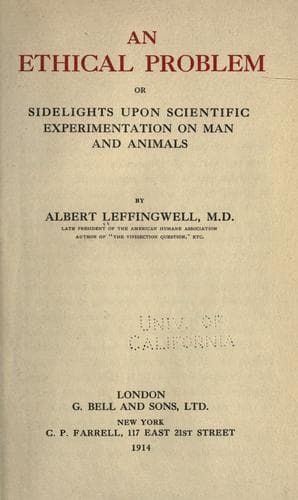
An ethical problem; or, Sidelights upon scientific experimentation on man and animalsLeffingwell, Albert
Philosophy
An ethical problem; or, Sidelights upon scientific experimentation on man and animals
Leffingwell, Albert
Medicine, Experimental; Vivisection
Nor is morphia an anaesthetic. "So far from suppressing sensibility
completely," says Claude Be'rnard in his lectures, "morphine sometimes
seems to exaggerate it." An animal under its influence "FEELS THE
PAIN, BUT HAS LOST THE IDEA OF DEFENDING HIMSELF."
We should have been very glad if the author had stated in his book the
precise experiments in which curare and morphia were employed. We are
told that the number was "few." But in comparison with the total
number--146--how many may that phrase signify? Were there twenty?
Possibly. It would seem that in every case after the preliminary
administration of anaesthetics--the dog's throat was cut, so that
artificial respiration could be easily maintained; "tracheotomy was
performed," to use the scientific phraseology. This is done when
curare is given, for then not the slightest movement of the tortured
animal can disturb the delicate instruments which are attached to it.
We may therefore assume that every case wherein only curare and
morphia were used--how many there were we do not know--implied torment
for the wretched victims.
Human beings are not submitted on the surgeons' table to operations of
this character, prolonged for hours. If, in the interest of Science,
some experimenter would place himself in like condition to that of the
animals upon which he worked; if, under anaesthesia--complete or
incomplete--he would permit a hand to be "crushed," a nerve trunk
"stimulated," his feet placed in boiling water "for a considerable
time," and a Bunsen's flame applied for two minutes to some part of
his body--we might possibly learn whether the acutest pains inflicted
could be absolutely suppressed. Perhaps he would survive to tell us;
but the animal cannot speak. No assurances suffice to clear our
doubts; assurances prove nothing. It may be, to use the words of a
great surgeon, that "in this relation, there exists a case of cruelty
to animals far transcending in its refinement and in its horror,
anything that has been known in the history of nations."
Such are some of the reasons which induce doubt of the theory that all
of the experiments of these vivisectors were conducted upon animals
wholly insensible to painful impressions. To become the victim of the
anaesthetic delusion regarding them is to justify; and to justify is
to share responsibility. But this is not all. There would seem to be
other evidence of the most convincing character, that some of the
animals thus subjected for hours to the stimulation of nerves and to
the most frightful mutilations were not at all times in such state of
unconsciousness as to prevent the occurrence of one most significant
indication of pain. It is proof to which the attention of the public,
so far as known, has never yet been directed; and I propose to
illustrate somewhat at length what has been done in the name of free
and unlimited vivisection, not only during the closing years of the
past century, but down almost to the present time.
Public-domain text, read in full here on John Shaqi.
Reviews
Reviews
No reviews yet
Be the first to share your thoughts on this work.
Elsewhere in the archive
Join the Discussion
Join the discussion
Sign in to leave a comment or review.
Sign InorCreate an account