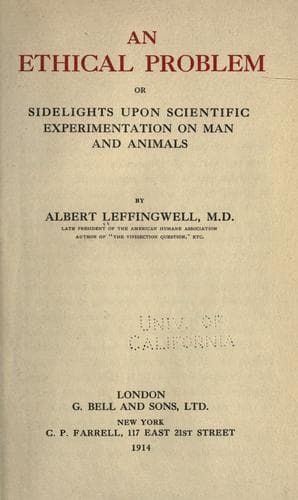
An ethical problem; or, Sidelights upon scientific experimentation on man and animalsLeffingwell, Albert
Philosophy
An ethical problem; or, Sidelights upon scientific experimentation on man and animals
Leffingwell, Albert
Medicine, Experimental; Vivisection
EXPERIMENT 12. "Burning right hind-foot caused a slight RISE IN BLOOD-
PRESSURE.
"Ten minims (drops) of chloroform on inhaler produced a DECIDED FALL
in blood-pressure."
EXPERIMENT 56. "Dog. Hind-foot burned, FOLLOWED BY A RISE IN BLOOD-
PRESSURE.... Burning the nose caused A VERY MARKED RISE in
blood-pressure. The animal, after the injection of cocaine, WAS NOT
UNDER FULL ETHER ANAESTHESIA, CUNJUNCTIVAL REFLEX BEING PRESENT."
EXPERIMENT 27. "Dog. Ether anaesthesia. Hind-foot was burned,
producing A SHARP RISE in the blood-pressure.
"Right paw again burned, and ARTERIAL PRESSURE ROSE.... Animal
subjected to FURTHER BURNING, which was followed by ADDITIONAL SLIGHT
RISE IN PRESSURE."
A considerable number of experiments involved the adding of hot salt
solution to the blood.
EXPERIMENT 34. Dog, in good condition. Saline solution in jugular
vein.... In this and in preceding experiments with the hot saline, the
animal, THOUGH UNDER SURGICAL ANAESTHESIA, STRUGGLED.
That shows the worth of the "surgical anaesthesia." When Professor
Starling was asked how he might know that the anaesthesia was passing
off, he told the Royal Commission that it was by noting the SLIGHT
MOVEMNET of the the animal, IN CONJUNCTION WITH A RISE OF BLOOD-
PRESSURE.[1] Scalding water in the blood seems to have given both of
these signs:
[1] Evidence before Royal Commission, Question 4,054.
EXPERIMENT 11. At 3.35 saline at 64 degrees C. (this is 147 degrees
F.). THE DOG STRUGGLED SOMEWHAT. The blood-pressure ROSE MARKEDLY.
3.45. Saline in jugular vein. Slight fall, then a quite ABRUPT RISE
in blood-pressure.... THE DOG AGAIN STRUGGLED VIGOROUSLY.
3.48. Saline at 60 degrees C. (140 degrees F.). Slight RISE in
blood-pressure. DOG STRUGGLED SOMEWHAT.
3.54. Saline at 60 degrees C. An immediate RISE in blood-pressure.
4.12. One-half drachm of chloroform on inhaler.
4.13. MARKED FALL in blood-pressure.
4.13. CHLOROFORM TAKEN AWAY. BLOOD-PRESSURE IMMEDIATELY AROSE to
previous level.
EXPERIMENT 32. A few drops of chloroform were given instead of ether,
the BLOOD-PRESSURE FALLING immediately.... After a few minutes,
several drops of chloroform were again administered, a marked FALL (of
blood-pressure) following.
One-half drachm of chloroform given, PRODUCING A GRADUAL FALL IN
BLOOD-PRESSURE. On removing the chloroform, the blood-pressure
recovered.
At 5.30, saline stopped. Eye reflex not gone. At 5.36 THE
ANAESTHESIA REMOVED. SLIGHT RISE in blood-pressure. REFLEXES NOT
ABOLISHED.
Does all this seem obscure to the reader? At all events, he can see
that the effect of even a "few drops of chloroform" is a fall of the
blood-pressure, and that when the "anaesthesia is removed" there comes
the rise which is so constantly associated with sensibility.
Some of the experiments related to the effect of cocaine in "blocking"
sensation. These effects have long been known; the necessity of all
this burning of flesh is not apparent.
Public-domain text, read in full here on John Shaqi.
Reviews
Reviews
No reviews yet
Be the first to share your thoughts on this work.
Elsewhere in the archive
Join the Discussion
Join the discussion
Sign in to leave a comment or review.
Sign InorCreate an account