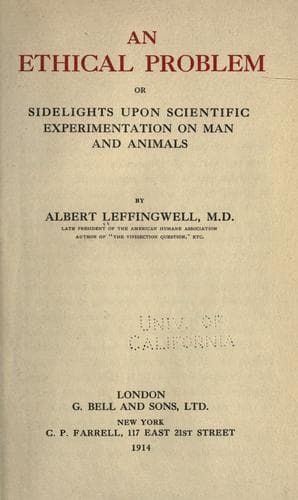
An ethical problem; or, Sidelights upon scientific experimentation on man and animalsLeffingwell, Albert
Philosophy
An ethical problem; or, Sidelights upon scientific experimentation on man and animals
Leffingwell, Albert
Medicine, Experimental; Vivisection
In the year 1900 the same vivisector published an account of certain
experiments on the respiratory system, 102 in all. We have the usual
assurances of anaesthesia, which, of course, can only be regarded as
the operator's opinion. Fire is an element of some of these
experiments. We are told that "a large blow-flame burner used for
glass-blowing supplied a flame that could be adjusted to a very great
range of intensity." Of this statemnet one can have no doubt upon
reading some of the experiments described. Upon "a healthy little
poodle," weighing only ten pounds, with a blood-pressure of 120
millimetres, the following experiment was made:
"The mouth was held wide open, and THE BLOW-FLAME DIRECTED INTO THE
PHARYNX AND RESPIRATORY TRACT. The immediate effect upon the blood-
pressure was A TEMPORARY RISE. Again the flame was applied; THE
BLOOD-PRESSURE ROSE TO 204 MILLIMETRES, CONTINUING AT THIS HIGH RATE
FOR SOME TIME."
Probably this little creature was the pet of some child. From whose
door, one day, did it wander, to be snatched up by some thief, sold to
a laboratory, and sent to a death like this?
In another experiment a Newfoundland dog "CONTINUOUSLY BREATHED THE
FLAME FOR TWELVE MINUTES." In a similar experiment that followed, "the
results were practically identical. In this case THE FLAME WAS SO
INTENSE AS TO MELT THE ADIPOSE TISSUE AROUND THE TRACHEA." The animal
was broiled alive.
During the first year of the twentieth century the same writer
presented the public an account of an "Experimental and Clinical
Research into Certain Problems," a work containing a considerable
number of experiments of a nature similar to those before published.
We are again told that in all cases "the animals were anaesthetized,
usually by ether, occasionally by chloroform," alone or combined with
other substances, although, in a few cases, "CURARE and morphine were
used"--neither of which is an anaesthetic. A curious statement seems
to imply a confession that all these experiments were not absolutely
painless, for the writer says:
"Every precaution was taken to inflict AS LITTLE PAIN OR DISTRESS AS
POSSIBLE."
Is not this an admission that in some experiments there was pain? How
senseless is such statement! When Ridley and Latimer were burnt alive
at Oxford, the executioner might have protested with equal assurance
that "every precaution was taken to burn the condemned with as little
pain and distress as possible."
Between the experiments recorded in this volume and those which have
been reviewed, there is no very great difference. There is a rise of
blood-pressure after any mutilation or stimulation calculated to cause
pain, except in the few cases where a sufficiency of the anaesthetic
appears to have been given; to these attention will be called. A new
procedure seems to have been the use of the injection of a hot salt
solution into the blood. Some of the results of experiments were as
follows:
Public-domain text, read in full here on John Shaqi.
Reviews
Reviews
No reviews yet
Be the first to share your thoughts on this work.
Elsewhere in the archive
Join the Discussion
Join the discussion
Sign in to leave a comment or review.
Sign InorCreate an account