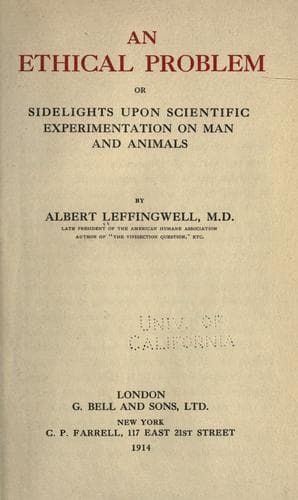
An ethical problem; or, Sidelights upon scientific experimentation on man and animalsLeffingwell, Albert
Philosophy
An ethical problem; or, Sidelights upon scientific experimentation on man and animals
Leffingwell, Albert
Medicine, Experimental; Vivisection
"This contention seems to me to flatly contradict the best conscience
of our time. The rights of the helpless--even though they be brutes--
must be protected by those who have superior power. The individual
vivisector must be held responsible to some authority which he fears.
The medical and scientific men, who time and time again have raised
their voices in opposition to all legal projects of regulation, KNOW
AS WELL AS ANYONE ELSE does the unspeakable possibilities of
callousness, wantonness, and meanness of human nature, and their
unanimity is the best example I know of the power of club opinion to
quell independence of mind. No well-organized sect or corporation of
men can ever be trusted to be truthful or moral when under fire from
the outside. In this case, THE WATCHWORD IS TO DENY EVERY ALLEGED
FACT STOUTLY; to concede no point of principle, and to stand firmly on
the right of the individual experimenter. His being `scientific'
must, in the eye of the law, be a sufficient guarantee that he can do
no wrong."
It may be questioned whether more serious charges against the
laboratory have ever been made than are contained in these statements
by an expert in vivisection. The man of the world wonders at the
unanimity of scienitfic writers of the day in opposing every step
tending to reform. Professor James tells us it is due to "the power
of club opinion to quell independence of mind." That the professional
vivisectors as a body "CANNOT BE TRUSTED TO BE TRUTHFUL WHEN
ATTACKED," that they combine "to deny every alleged fact stoutly,"
these are the admissions of an expert experimenter, whose record as a
man of science is surely equal if not superior to that of any
vivisector in America.
Professor James believed that some abuses had been rectified. He
says:
"That less wrong is done now than formerly is, I hope, true. There is
probably a somewhat heightened sense of responsibility. There are,
perhaps, fewer lecture-room repetitions of ancient vivisections,
supposed to help out the professors' dulness with their brilliancy,
and to `demonstrate' what not six of the students are near enough to
see, and what all had better take, as in the end they have to, upon
trust. The waste of animal life is very likely lessened, the thought
for animal pain less shamefaced in the laboratories than it was.
These benefits we certainly owe to the antivivisection agitation,
which ,in the absence of producing actualy State regulation, has
gradually induced some sense of public accountability in
physiologists, and made them regulate their several individual selves.
Public-domain text, read in full here on John Shaqi.
Reviews
Reviews
No reviews yet
Be the first to share your thoughts on this work.
Elsewhere in the archive
Join the Discussion
Join the discussion
Sign in to leave a comment or review.
Sign InorCreate an account