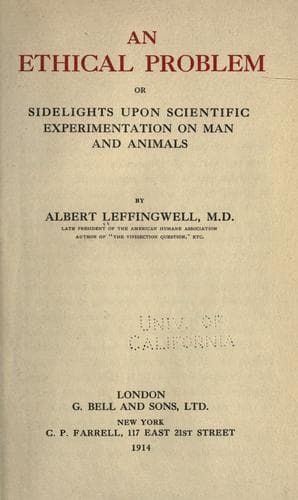
An ethical problem; or, Sidelights upon scientific experimentation on man and animalsLeffingwell, Albert
Philosophy
An ethical problem; or, Sidelights upon scientific experimentation on man and animals
Leffingwell, Albert
Medicine, Experimental; Vivisection
"But how infinitely more wisely and economically would these results
have come if the physiologists as a body had met public opinion half-
way long ago, agreed that the situation was a genuinely ethical one,
and that their corporate responsibility was involved, and had given up
the preposterous claim that every scientist has an unlimited right to
vivisect, for the amount or mode of which no man, not even a
colleague, can call him to account.[1]
"The fear of State rules and inspectors on the part of the
investigators is, I think, well founded; they would probably mean
either stupid interference or become a sham. But the public demand
for regulation rests on a perfectly sound ethical principle, the
denial of which by the scientists speaks ill for either their moral
sense or their political ability. So long as the physiologists
disclaim corporate responsibility, formulate no code of vivisectional
ethics for laboratories to post up and enforce, appoint no censors,
pass no votes of condemnation or exclusion, propose of themselves no
law, so long must the antivivisectionist agitation, with all its
expensiveness, idiocy, bad temper, untruth, and vexatiousness,
continue, as the only possible means of bringing home to the careless
or callous individual experimenter the fact that the sufferings of HIS
animals are somebody else's business as well as his own, and that
there is `a God in Israel' to whom he owes account.
"WILLIAM JAMES.
"Cambridge, Mass.,
"May 5 (1909)."
[1] "Unnecessary and offensive in the highest degree would it be,
... by legislation of any kind, to attempt to dictate or control how,
and by whom, and for what purposes, and under what conditions and upon
what animals in the laboratories, ... experiments should be made. The
decision in these matters SHOULD BE LEFT WHOLLY TO THOSE IN CHARGE OF
THESE INSTITUTIONS."--From a memorial of Dr. Simon Flexner,
Dr. W. T. Councilman, Dr. H. C. Ernst, and other members of the
Association of American Physicians against Senate Bill regulating
vivisection in the District of Columbia, May 4, 1896.
This is a very strong indictment. If he misunderstood the
antivivisectionists, we must remember that Henry Clay in 1851 could
see nothing good in William Lloyd Garrison and the Abolition party.
But James knew precisely what the vivisection of animals meant, for he
had taught physiology, and had been engaged in experimentation for
more than a quarter of a century. When he speaks of the power of
"club opinion to quell independence of mind," he explains a situation
which otherwise might remain obscure. When he asserts that certain
groups "cannot be trusted to be truthful or moral," we have the
explanation of a philosopher who was not given to over-statement.
Public-domain text, read in full here on John Shaqi.
Reviews
Reviews
No reviews yet
Be the first to share your thoughts on this work.
Elsewhere in the archive
Join the Discussion
Join the discussion
Sign in to leave a comment or review.
Sign InorCreate an account