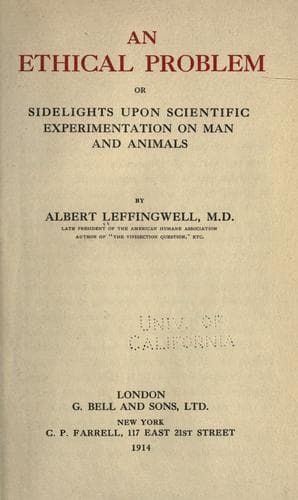
An ethical problem; or, Sidelights upon scientific experimentation on man and animalsLeffingwell, Albert
Philosophy
An ethical problem; or, Sidelights upon scientific experimentation on man and animals
Leffingwell, Albert
Medicine, Experimental; Vivisection
Ought we not to go beyond this and require reports to state the facts
regarding anaesthetics? Eventually such information should undoubtedly
be required. So far as the immediate present is concerned, it would
seem perhaps the wiser course not to complicate the inquiry in this
way. There are vivisectors who would declare that "anaesthetics are
always used" when ether or chloroform has been given in quantity and
in time absolutely insufficient to secure for the vivisected animal
immunity from pain. Sometimes we shall ask how many animals and of
what species are subjected to mutilations and observations that last
for days and weeks, and how many, if any, have had "nerves torn out by
the roots," as one American physiologist connected with a medical
school tells us he has repeatedly done. Into the thousand and one
phases of experimentation Society must one day make inquiry. But may
it not be best to wait till some knowledge of the leading facts are
secured? A report regarding anaesthesia might be utterly useless,
except to keep hidden the very facts we wish to know. What some of
these facts are may be indicated hereafter, but it would seem best not
to include them in any present demand.
What may we conceive will be the attitude of the laboratory interests
toward any attempt to secure information concerning the practice, not
by State inspection, but by and through reports made by themselves? If
the popular conceoption of physiological investigation were true,
should we not be sure of the hearty approval of all physiologists
regarding any measure so calculated to remove misunderstanding and
distrust? Here would be the wished-for opportunity to demonstrate the
vast importance of the problems pursued, and the wonderful results
attained compared with the small cost of animal life, the humane and
ever-present solicitude of the experimenter, the immunity from
suffering. Here, too, we should have that "organized, systematic, and
absolute frankness" in regard to the practice of vivisection, for
which one of its greatest American defenders once appealed. But, on
the other hand, suppose that the laboratory in England and America
dare not permit the whole truth to be known? Suppose that it would not
willingly permit the general public to know even the number of animals
which are now sacrificed in the demonstration of well-known facts?
Then assuredly the laboratory interests will unite to prevent any
legislation that could tend to destroy the secrecy that now exists, or
to bring the facts of vivisection to the light of day. Which
hypothesis is the true one, some day will reveal. We shall then
discover whether the laboratory will yield to a demand for publicity,
or whether, contending for continued secrecy, faithless to Science, it
will resist every attempt to make known the whole truth, and cling to
the ideals and traditions of the Spanish Inquisition of three hundred
years ago.
CHAPTER XIV
Public-domain text, read in full here on John Shaqi.
Reviews
Reviews
No reviews yet
Be the first to share your thoughts on this work.
Elsewhere in the archive
Join the Discussion
Join the discussion
Sign in to leave a comment or review.
Sign InorCreate an account