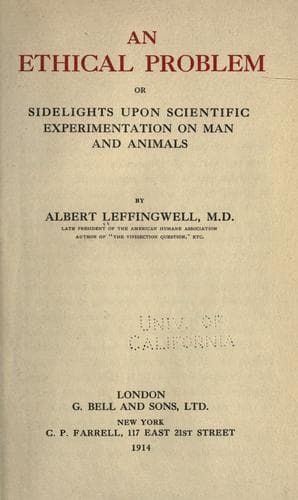
An ethical problem; or, Sidelights upon scientific experimentation on man and animalsLeffingwell, Albert
Philosophy
An ethical problem; or, Sidelights upon scientific experimentation on man and animals
Leffingwell, Albert
Medicine, Experimental; Vivisection
THE WORK OF REFORM SOCIETIES
It is necessary to make a distinction between societies aiming to
destroy animal experimentation, root and branch, and those which hope
only to prevent abuses and cruelties. Antivivisection societies have
been organized in different States. Of their activities it is not
necessary here to speak. But another kind of organization has made
its appearance, societies aiming solely at the prevention of abuse and
the restriction of the practice within limits compatible with humane
ideals.
The first society in America organized for the express purpose of
prevention of cruelty in animal experimentation appears to have been
the American Antivivisection Society, founded at Philadelphia in
1883. The object of the society, as defined by its first charter, was
"the restriction of the practice of vivisection within proper limits,
and the prevention of the injudicious and needless infliction of
suffering upon animals under the pretence of medical or scientific
research." To Mrs. Caroline Earle White of Philadelphia, more than to
any other, was due the credit of bringing this first society of
protest into being over thirty years ago.
It was believed by the founders of this society that the medical
profession--so many members of which had recognized the reality of the
abuses and the necessity of reform--would join in some common endeavor
to restrict and to regulate the practice. But attempts in direction
of any legislation met with decided opposition from the principal
laboratories in the State, and although a few physicians of eminence
lent their influence to the promotion of reform, the great body of
medical practitioners stood aloof. And gradually the founders of the
society came to believe that their position was wrong; that the policy
of concession and compromise ought to be abandoned, and that instead
of asking that any experimentation be legalized, the society should
demand the total abolition of all experiments upon living animals.
At a meeting held in 1887 a resolution was brought forward favouring
the change of the name of the society and the aim which hitherto they
had had in view. Opposition merely to experiments of a painful
character was not sufficient; from that time forward every phase of
experimentation was equally to be condemned. The resolution was
carried. And now for more than a quarter of a century the society has
striven to influence public sentiment in favour of its ideal, the
total suppression of all scientific experiment upon living animals,
whether painful or otherwise. It is needless to say that they have
done this in the face of innumerable obstacles, and doubtless with a
recognition of the impossiblity of present success. Three times they
have introduced into the Legislature of the State of Pennsylvania a
Bill for some restriction of animal experimentation, and always
without avail.
Public-domain text, read in full here on John Shaqi.
Reviews
Reviews
No reviews yet
Be the first to share your thoughts on this work.
Elsewhere in the archive
Join the Discussion
Join the discussion
Sign in to leave a comment or review.
Sign InorCreate an account