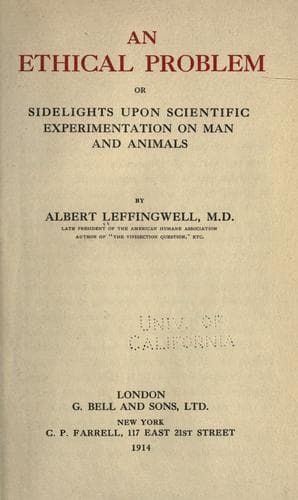
An ethical problem; or, Sidelights upon scientific experimentation on man and animalsLeffingwell, Albert
Philosophy
An ethical problem; or, Sidelights upon scientific experimentation on man and animals
Leffingwell, Albert
Medicine, Experimental; Vivisection
To demonstrate the truth of such a charge would require a volume. Let
it here suffice to mention a few instances of what may at least be
termed an unfairness in controversy. Partly, of course, it is the
result of ignorance, and of imperfect acquaintance with the past
history of vivisection; partly it is due to that enthusiasm of youth
which sometimes prefers a seeming victory to any close fidelity to
truth. Other instances cannot be thus explained. Some of them are
worth consideration as problems for which no solution is easily to be
found.
In January, 1913, a Bill was introduced into the New York Legislature
providing for an inquiry into the practice of animal experimentation.
There was no suggestion of any restriction of vivisection; it was
simply an attempt to get at the real facts concerning the practice as
now carried on. If it be assumed that no objectionable practices
exist, it would seem difficult to oppose such inquiry upon any
reasonable grounds. It might possibly have been expected that the
Laboratory would welcome the opportunity to demonstrate to the general
public that nothing deserving censure could be found to exist.
For reasons not difficult to understand, the proposal to investigate
the laboratory and its methods has been resisted quite as strongly as
if it had been an attempt to prohibit experiments altogether. To
justify rejection of inquiry would not appear to be an easy task. To
create a sentiment of approval of the policy of secrecy it doubtless
seemed necessary to make an appeal to the general public by editorial
utterances, in journals supposed to be impartial and of high standing
in other directions. In a New York daily paper which claims to be
conducted with special regard for respectability and avoidance of
unseemly sensationalism, there appeared, therefore, an editorial
opposing all inquiry on the part of the legislature into the methods
of animal experimentation. It is worth while to see how matters of
history were placed before its readers by one of the most reputable of
New York journals:
"... An outcry was raised against the English doctors in the early
seventies, and it was decided to investigate their laboratories. A
Royal Commission was appointed in 1875 by Queen Victoria. The
Commission took elaborate testimony, and found no material abuse; but
owing to the inflamed state of the public mind, and the attitude of
many members of the medical profession, who at that early date did not
appreciate the importance of the experimental method, a restrictive
law was recommended, which resulted in the calamitous measure of 1876.
Public-domain text, read in full here on John Shaqi.
Reviews
Reviews
No reviews yet
Be the first to share your thoughts on this work.
Elsewhere in the archive
Join the Discussion
Join the discussion
Sign in to leave a comment or review.
Sign InorCreate an account