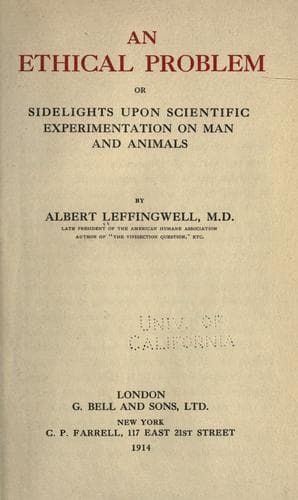
An ethical problem; or, Sidelights upon scientific experimentation on man and animalsLeffingwell, Albert
Philosophy
An ethical problem; or, Sidelights upon scientific experimentation on man and animals
Leffingwell, Albert
Medicine, Experimental; Vivisection
"Far from allaying the British agitation, as was expected, the
investigation only served to stimulate it.... A demand was made in
1906 for a second full investigation of laboratory methods. Again a
Royal Commission was created, which took testimony for a year and
half. Its report, submitted in March last year, overwhelmingly
disproved the charges that the medical experiments upon animals are
immoral and unjustifiable.... THE DOCTORS OF ENGLAND HAVE FOR A
GENERATION HAD TO FLEE TO THE CONTINENT to prosecture their necessary
labours. Is the experience of Great Britain to be repeated in the
United States at the hands of persons who have become deluded into
insensibiity to human suffering?"[1]
[1] Editorial in New York Times, January 28, 1913.
Now, this editorial utterance is not exceptionally misleading. In
scores of newspapers throughout the United States just as ignorant and
as prejudiced statements find editorial expression every year. It
aims to justify the closing of the laboratory to all investigations
whatever, and it attempts to do this by misstatements regarding
historical facts. It tells us of an "outcry raised against the
English doctors in the early seventies," forgetting to mention the
attacks made by the British Medical Journal, the Lancet, and other
medical periodicals, against the terrible cruelties of the practice
long before the "early seventies." The Royal Commission of 1875, we
are told, "found no material abuse." What is meant by the qualifying
adjective "material"? Let us see how the inquiry impressed an
impartial observer, the Lord Chief Justice of England.
"Is, then, the present law reasonable? It is the result of a most
careful inquiry, conducted by eminent men in 1875, men certainly
neither weak sentimentalists nor ignorant and prejudiced
humanitarians, men among whom are to be found Mr. Huxley and
Mr. Erichsen, Mr. Hutton, and Sir John Karslake. There men
unanimously recommended legislation, and legislation, in some
important respects, more stringent than Parliament thought fit to
pass. They recommend it on a body of evidence at once interesting and
terrible. Interesting, indeed, it is from the frank apathy to the
suffering of animals, however awful, avowed by some of the witnesses;
for the noble humanity of some few; for the curious ingenuity with
which others avoided the direct and verbal approval of horrbile
cruelties which yet they refused to condemn.... Terrbile the evidence
is for the details of torture, of mutilation, of life slowly destroyed
in torment, or skilfully prolonged for the infliction of the same or
diversified agonies, for days, for months, in some cases for more than
a year."[1]
[1] Fortnightly Review, February, 1882.
This was the view of the Lord Chief Justice of England of that day;
and yet the unknown scribe, writing in a New York newspaper, without
adducing a particle of evidence, would have his readers to believe
that the Commission of 1875 "FOUND NO MATERIAL ABUSE."
Public-domain text, read in full here on John Shaqi.
Reviews
Reviews
No reviews yet
Be the first to share your thoughts on this work.
Elsewhere in the archive
Join the Discussion
Join the discussion
Sign in to leave a comment or review.
Sign InorCreate an account