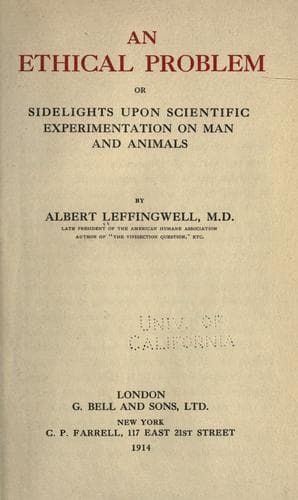
An ethical problem; or, Sidelights upon scientific experimentation on man and animalsLeffingwell, Albert
Philosophy
An ethical problem; or, Sidelights upon scientific experimentation on man and animals
Leffingwell, Albert
Medicine, Experimental; Vivisection
Equally unfair and inaccurate is the editorial reference to the report
of the Royal Commission of 1906. The conclusions set forth in this
report cannot possibly be stated in a single sentence without leaving
essential matters unstated. The six principal recommendations of the
Royal Commission were all in the direction of reform, AND OF REFORM
THAT IMPLIED THE EXISTENCE OF ABUSES that requierd change. The
subject has been treated in a previous chapter, and need not occupy
attention again.
But the worst misstatement in this editorial intended to incite
prejudice against any inquiry in the State of New York was that which
referred to the effect of the English law governing the regulation of
vivisection. It is now nearly forty years since this law came into
force. The editor speaks of it as "the calamitous measure of 1876";
and after declaring that "the doctors of England have for a generation
had to flee to the Continent to prosecute their necessary labours,"
asks his readers whether "the experience of Great Britain is to be
repeeated in the United States?" If this assertion were true, then
assuredly the law would have been regarded with detestation and
abhorrence by the medical profession of England, and by the teachers
of medical science throughout the land.
Now, it so happens that the impression given is wholly false. It did
not originate with the editorial writer; for many years the assumed
evil results of the English law have been held up for our warning by
those who desire a free hand in vivisection in America. But is it
true that the law of 1876 is regarded in England as a calamitous
measure, which Parliament should hasten to repeal? On the contrary, so
far from being thus regarded, a large majority of the representatives
of medical science in England are in favour of the law. Of course,
every authority can suggest modifications for its betterment, but the
principle which underlies the measure, of inspection of laboratories
and the restriction of vivisection, they do not condemn. That it is a
perfect measure, the leaders of the medical profession do not assert,
but they evidently consider it as better than no law at all. It
certainly is not considered, as the American editor calls it, "the
calamitous measure of 1876."
The proofs of this attitude of the English medical profession may be
found in the evidence given before the Royal Commission on
Vivisection, the final report of which appeared in 1912. The
misapprehension concerning the working of the English law is so
widespread in America and is so sedulously cultivated by those who
oppose any reform, that it seems worth while to show just how the law
is regarded in the land to which it applies.
Public-domain text, read in full here on John Shaqi.
Reviews
Reviews
No reviews yet
Be the first to share your thoughts on this work.
Elsewhere in the archive
Join the Discussion
Join the discussion
Sign in to leave a comment or review.
Sign InorCreate an account