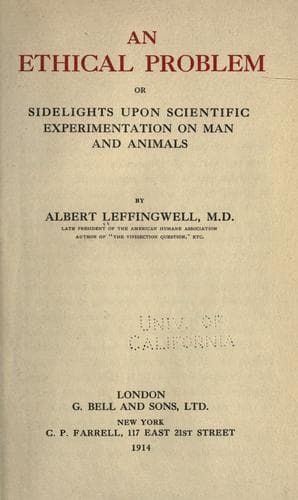
An ethical problem; or, Sidelights upon scientific experimentation on man and animalsLeffingwell, Albert
Philosophy
An ethical problem; or, Sidelights upon scientific experimentation on man and animals
Leffingwell, Albert
Medicine, Experimental; Vivisection
From every man's correspondence Death at last removes the seal; and
Lister's true story surely may now confront the distorted fiction
which in America for many years has been given so wide a publicity.
The facts are indeed different from the legend which for more than a
quarter of a century has been repeated as a convincing argument
against reform. Of the malign influence of such a tale upon public
opinion in preventing legislation in America, we can form no adequate
estimate. For any intentional deception we may, of course, absolve
the distinguished professional man who has made himself responsible as
transmitter of the myth; no man with any conception of honour would
state as facts what he knew to be false. But from the charge of
carelessness, of gross inaccuracy, is one as readily to be freed? For
a quarter of a century the statement has been in circulation--that
when Lister desired to make most important researches, "so many
obstructions were thrown in his way in England, that HE WAS DRIVEN TO
TOULOUSE to pursue his humane researches"; and now Lister's letter
shows us that he "could, no doubt, have obtained a licence to do them
here"--showing that he did not even ask permission to experiment. In
1900 the public was informed that Lister "was obliged to go to France
to carry on his experiments"; the readers of Harper's are told that
"Lord Lister was COMPELLED TO GO TO FRANCE by reason of the stringency
of the English antivivisection laws"; and now Lister writes that going
to France was a matter of convenience, and not of necessity; that at
the Veterinary College "I dare say I might have had the opportunity
given me for the investigation"--showing that the opportunity had
never been sought! Yet the influence of the untruth will continue for
many a year.
Of Lister's extreme antipathy to the antivivisectionists and to th
erestriction of animal experimentation there can be no doubt. That he
misapprehended the effect of the law of 1876 we know; he imagined that
even the observation of the circulation of the blood in a frog's foot
under the microscope by an unauthorized investigator would render the
student liable to a criminal prosecution. We can be very sure that if
this were true, the Act of 1876 would never have escaped the
condemnation of the scientific men whose opinions have been quoted
from evidence given before the Royal Commission, men who found in this
Act no impediment to any reasonable investigation. But when the
reports of personal experience were brought to Lister's notice, he was
willing to correct their gross exaggerations; yet--to avoid
controversy, perhaps--he desired that the facts should not be
published, and during his lifetime, compliance was given to his wish.
Public-domain text, read in full here on John Shaqi.
Reviews
Reviews
No reviews yet
Be the first to share your thoughts on this work.
Elsewhere in the archive
Join the Discussion
Join the discussion
Sign in to leave a comment or review.
Sign InorCreate an account