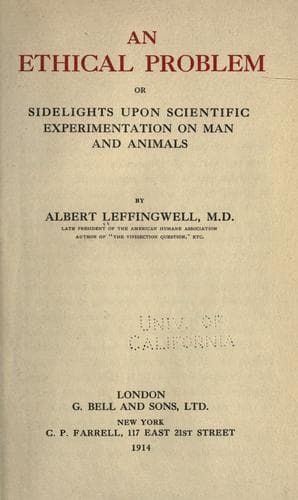
An ethical problem; or, Sidelights upon scientific experimentation on man and animalsLeffingwell, Albert
Philosophy
An ethical problem; or, Sidelights upon scientific experimentation on man and animals
Leffingwell, Albert
Medicine, Experimental; Vivisection
The phase of untruthfulness in the defence of unrestricted
experimentation deserves far more attention than can here be
accorded. One is loth to regard as possible any intent to deceive;
the inaccuracy and exaggeration are undoubtedly due chiefly to
ignorance on the part of men who ought to be well-informed, because
the world looks to them for statements of fact concerning the benefits
claimed to be due to experimentation. Take, for instance, an
assertion made in testimony given before the Royal Commission by Sir
Victor Horsley, a Fellow of the Royal Society, and the representative
of the British Medical Association. Referring to pyaemia, or blood-
poisoning, he was not content to affirm the disappearance of these
formidable maladies from the hospital to which he was attached, but
went on to declare their disappearance altogeher. "Anybody," said Sir
Vitor Horsley, "who would now be asked to write an article on pyaemia
or blood-poisoning in a dictionary of surgery, COULD NOT DO IT; THE
DISEASES ARE GONE!"[1]
[1] Evidence before Royal Commission, Question 15,669.
This statement is a most remarkable one. The witness was once widely
known as a ruthless experimenter upon living animals, and he was now
defending the practice by an enumeration of its gains. Apparently,
no member of the Commission questioned his evidence; the
representative of the British Medical Association solemnly affirmed
that as a result of vivisection certain diseases had so completely
disappeared that present observation or description was impossible,
and the Royal Commission accepted his word. The statement that these
septic diseases had disappeared crossed the Atlantic, and nearly six
years afterward, in the columns of a New York journal, it again
appeared.[2] Yet the statement was untrue. It is indeed difficult to
believe that any educated medical man in England or America could have
read it without recognition of its untruth. Let us glance at the
evidence.
[2] New York Times, July 28, 1912.
If it were true that the septic diseases which relate to blood-
poisoning had really been so completely abolished that description of
them were now impossible--as Sir Victor Horsley declared--it is
evident that as causes of any part of English mortality they would
cease to appear. The report of the Registrar-General of England and
Wales tells a very different story. Sir Victor Horsley gave this
testimony in November, 1907. During the five years preceding, and
ending December 31, 1907, NO LESS THAN 2,933 PERSONS DIED FROM BLOOD-
POISONING (PYAEMIA AND SEPTICAEMIA) IN ENGLAND AND WALES. During the
year 1907, the year that testimony was given, the tribute of 604 lives
was exacted by these diseases which had "GONE"! Even during the year
following (1908), the recorded deaths due to blood-poisoning in
England and Wales were 560; and yet the disease had been solemnly
declared to be non-existent by the leading defender of English
vivisection!
Public-domain text, read in full here on John Shaqi.
Reviews
Reviews
No reviews yet
Be the first to share your thoughts on this work.
Elsewhere in the archive
Join the Discussion
Join the discussion
Sign in to leave a comment or review.
Sign InorCreate an account