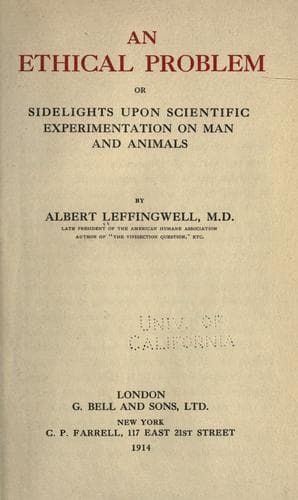
An ethical problem; or, Sidelights upon scientific experimentation on man and animalsLeffingwell, Albert
Philosophy
An ethical problem; or, Sidelights upon scientific experimentation on man and animals
Leffingwell, Albert
Medicine, Experimental; Vivisection
Nor is this all. In proportion to the total population the death-rate
from blood-poisoning WAS HIGHER DURING THE YEAR THAT SIR VICTOR
HORSLEY GAVE THIS ASTOUNDING TESTIMONY THAN IT WAS EVEN FORTY YEARS
BEFORE. In 1868, in England and Wales, to a million persons living,
the death-rate from septic diseases, or blood-poisoning, was fifteen;
the year following it was sixteen. In 1870 it rose to eighteen,
falling, however, to sixteen for the next two years. Nearly forty
years go by, and we find a leading English vivisector assuring a Royal
Commission that blood-poisoning had so completely disappeared that a
medical writer could not describe it; and the Registrat-General
charging this extinct disease with a death-rate of nineteen in 1906
and eighteen in 1907, A HIGHER RATE OF MORTALITY THAN A GENERATION
BEFORE![1]
[1] For these statistics see reports of the Registrar-General of
England and Wales, 54th Report, Table 16, and 73rd Report, Table 22.
These are officially stated facts. At the cost of half a crown Sir
Victor Horsley might have learned that the diseases he so glibly
declared had "gone" were still responsible for a part of English
mortality, and a greater proportion even than during thirty-five to
forty years before. It is this gross ignorance on the part of those
who would teach us, this willingness in the defence of all phases of
vivisection, to make assertions which are without foundation in fact,
that justly tends to create distrust of every such statement,
unsupported by proof. We are not questioning the value of asepsis,
which is only a learned phrase to express absolute surgical
cleanliness. The time may come when these septic forms of disease
will entirely disappear. That day, however, has not yet arrived. Why
declare that it is already here? Why proclaim that diseases had "GONE"
which still existed, or that an enemy had been utterly exterminated
which still was responsible for hundreds of deaths?
Nor are English medical writers alone guilty of blunders and
exaggerations concerning the effect of experiments on animals. In the
number of Harper's Monthly for April, 1909, to which we have referred,
an American writer blunders quite as badly as his English confre`re.
He tells us that "the friends of experimental research have almost
completely abolished the dangers of maternity, reducing its death-rate
FROM TEN OR MORE MOTHERS OUT OF EVERY HUNDRED, to less than one in
every hundred."
Public-domain text, read in full here on John Shaqi.
Reviews
Reviews
No reviews yet
Be the first to share your thoughts on this work.
Elsewhere in the archive
Join the Discussion
Join the discussion
Sign in to leave a comment or review.
Sign InorCreate an account