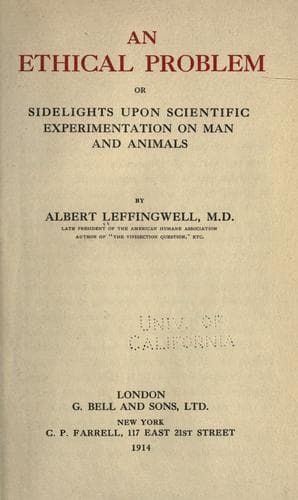
An ethical problem; or, Sidelights upon scientific experimentation on man and animalsLeffingwell, Albert
Philosophy
An ethical problem; or, Sidelights upon scientific experimentation on man and animals
Leffingwell, Albert
Medicine, Experimental; Vivisection
A significant illustration of the steady increase in the mortality
from cancer is shown by its fatality among women in England between
the ages of forty-five and sixty-five. In the year 1875, of all
deaths of women at this period of life, one in ten (in round numbers)
was due to some form of malignant disease. In 1890 the tribute
exacted by the disease had become one in eight. Ten years later--in
1900--of all women dying in England during this period of middle life,
the toll of cancer was one in seven; and in 1910 the corresponding
proportion was one in five! At this rate of increase it will not be
many years before a full third of all the deaths of women at this time
of life will be due to malignant disease. There can be little doubt
that the same phenomenon would be found to pertain to American
experience, were it possible to disentangle the facts from the
obscurity in which they are now permitted to lie. It is a curious
fact that in England until the year 1900--and, so far as we know, for
thousands of years--the death-rate from consumption among women was
considerably higher than that of malignant disease; that in 1903, for
the first time, the cancer-mortality of women exceeded that of
phthisis; and that in 1910 it had so far surpassed it that they are
not likely ever again to be equal, unless we shall discover the cause
of the more fatal plague.
The theory has been put forth by certain writers that the increased
death-rate from cancer is due, not to any increased frequency of the
dissease, but rather to improved methods of detection. It is quite
certain that fifty years ago, for instance, surgeons were less able
and less willing to pronounce judgment regarding obscure cases of
internal tumours. But if the better diagnosis of to-day accounts for
some part of this increase since 1860, it does not seem probable that
it can explain the rising death-rate of the last ten or fifteen
years. The medical practitioner of 1900 was certainly as well
qualified to pronounce upon the character of the disease as the
surgeon or physician of to-day. Nevertheless, the cancer death-rate
of England in 1910 had increased 16 per cent. above that of ten years
before, and during the fifteen years 1895-1900 it had increased fully
28 per cent. Certainly in these last few years there has been no such
increased ability to detect the disease as would account for all
this. Yet another fact suggests doubt of this optimistic hypothesis.
If the increased cancer death-rate were due merely to the increased
ability of the physician or surgeon to recognize the ailment, we
should certainly find that the increase of cancer would be seen only
in those parts of the system, such as internal organs, where some
degree of doubt might perhaps be entertained; while, on the other
hand, there would be little or no increase discernible in the
mortality of cancers affecting parts of the body where its nature
could not be mistaken by any intelligent physician or surgeon. Now,
Public-domain text, read in full here on John Shaqi.
Reviews
Reviews
No reviews yet
Be the first to share your thoughts on this work.
Elsewhere in the archive
Join the Discussion
Join the discussion
Sign in to leave a comment or review.
Sign InorCreate an account