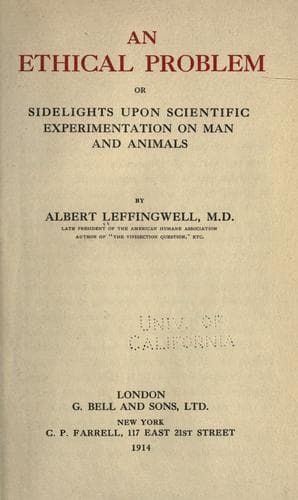
An ethical problem; or, Sidelights upon scientific experimentation on man and animalsLeffingwell, Albert
Philosophy
An ethical problem; or, Sidelights upon scientific experimentation on man and animals
Leffingwell, Albert
Medicine, Experimental; Vivisection
for a number of years, perhaps with this hypothesis in view, the
Registrar-General in England has tabulated all deaths from cancer of
either sex, not only by different age-periods, but also by the part of
the body affected by the fatal disease. A study of the facts thus
made known is extremely suggestive. It is true that a marked increase
in the death-rate has occurred in cancer affecting internal organs, as
we should naturally suppose; but it is also true that malignant
disease affecting parts of the body where little or no doubt of the
character of the ailment could be entertained by the physician,
exhibit in some instances as marked an increase in the death-rate as
in some other cases, where doubt of malignancy might be justifiable.
For example, cancer of the tongue among men showed a death-rate of 32
per million population in 1897; it went up to 47 per million in 1910--
an increase of nearly 50 per cent. Cancer of the female breast showed
a death-rate of about 142 per million population in 1897; it had
arisen to a rate of 190 per million only thirteen years later; and
here, assuredly, the nature of the disease in fatal cases cannot be
mistaken.[1] Cancer of the stomach in its final stages does not
present insuperable difficulties in way of diagnosis, but the
death-rate increased for men about 40 per cent. in fifteen years; and
although some of this increase may be due to more careful
discrimination between cases of malignant disease affecting the liver,
yet this explanation cannot account for the increase when both organs
are considered together. The subject is worthy of careful and
extended investigation, but even a cursory examination of the facts
now available indicate a real increase in the death-rate from cancer
in England, and probably in every other civilized country in the
world.
[1] "During fourteen years ... the mortality from mammary cancer has
increased by about 29 per cent., NOTWITHSTANDING LIVES SAVED BY
IMPROVED METHODS OF OPERATION."--Registrar-General's Report for 1910,
p. 69.
But all these phenomena are of secondary importance compared with the
great problem of medical science--the yet undiscovered cause of
malignant disease. During recent years the study of cancer has been
conducted with scientific enthusiasm in many laboratories. Vast sums
of money have been given, in the hope that these studies may one day
lead to the discovery of a cure. One whom I knew in his youth became
the heir of great wealth; lived to see one whom he loved perish from
the disease; was struck down himself, and dying, left a fortune for
the purpose of promoting research concerning cancer. And yet to-day
the problem, as attacked in the various laboratories of Europe and
America, is apparently as far from solution as it was forty years
ago. Sir Henry Butlin, ex-President of the Royal College of Surgeons,
England, is said to have operated on as many cases of cancer as any
surgeon of his day. Yet, speaking in October, 1911, he said:
Public-domain text, read in full here on John Shaqi.
Reviews
Reviews
No reviews yet
Be the first to share your thoughts on this work.
Elsewhere in the archive
Join the Discussion
Join the discussion
Sign in to leave a comment or review.
Sign InorCreate an account